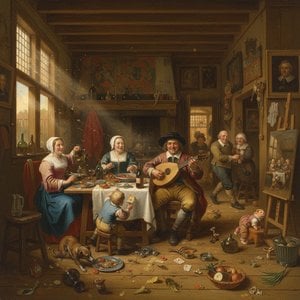
The Quiet Presence of a Flemish Painter
Jan Verhoeven emerged from the artistic traditions of Mechelen, Belgium, during a period of profound cultural shifts in the seventeenth century. Born around 1590, his life was rooted in the Southern Netherlands, a region where the Baroque style began to define the visual language of the era. He was a student of Pierre Sillevoorts, a connection that likely helped shape his early understanding of form and composition. His work reflects the diverse interests of a professional painter of his time, moving between the structured demands of history painting and the more intimate observations of portraiture and landscape.
His career was defined by a versatility that allowed him to navigate various genres. He did not limit himself to a single subject, instead addressing the needs of a society that valued both the grand narratives of history and the specific likenesses of its citizens. This adaptability was a hallmark of the Flemish School, where artists were expected to master multiple modes of expression to sustain a professional practice.
A Record of Skill and Subject Matter
The surviving evidence of Verhoeven’s output reveals a painter capable of capturing the social fabric of his era. His technical focus spanned several distinct areas of the visual arts:
- Genre painting, which captured the everyday scenes of contemporary life.
- History painting, the high art of depicting significant narrative events.
- Landscape painting, focusing on the natural world.
- Portraiture, providing a visual record of individuals and their status.
One of his most notable surviving works is the Portrait of Rombout Heyns, alias Smets, Ensign of the Kolveniersgilde in 1580. This piece, currently held in the Museum Hof van Busleyden, offers a glimpse into the meticulous way he approached his subjects. It serves as a window into the civic life of Mechelen, documenting the figures who held positions of responsibility within the local guilds.
The Final Years in Mechelen
Verhoeven remained tied to his origins throughout his life, passing away in Mechelen in 1676. His long life spanned much of the seventeenth century, a time when the Baroque style moved from its early developments into a more established presence across Europe. While the specific details of his personal struggles or triumphs remain largely unrecorded, his place in the history of Flemish painting is secured by the works he left behind. He remains a representative figure of the Mechelen school, a painter whose hand contributed to the visual identity of the Southern Netherlands.
Q&A
Jan Verhoeven 작가는 어떤 사조의 작품 활동을 했나요?
Jan Verhoeven의 작품은 작가의 모든 미술 사조 페이지에서 사조별로 만나보실 수 있습니다.
특정 주제별로 Jan Verhoeven의 작품을 어떻게 찾아볼 수 있나요?
특정 주제의 Jan Verhoeven 작품을 찾으려면 키워드별로 작품이 분류된 작가의 키워드별 탐색 페이지를 이용해 보세요.
Jan Verhoeven은(는) 어느 시대의 작품을 남겼나요?
Jan Verhoeven은(는) Early Modern 시대에 활동했습니다. 이 시기는 역사적 맥락 속에서 작가의 예술적 위치를 보여줍니다.
주제별로 Jan Verhoeven의 작품을 찾아볼 수 있나요?
Jan Verhoeven의 주제별 작품 모음는 작가의 작품들을 주제별로 찾아볼 수 있는 페이지입니다.