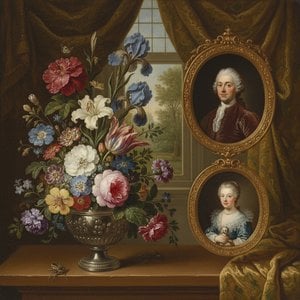
A Life Shaped by the Brush and the Draft
In the quiet town of Naarden, a young boy began a life that would eventually weave through the very fabric of the Dutch Golden Age. Born to a father who practiced the healing arts as a doctor, Jan van Neck did not find his calling in medicine, but rather in the delicate precision of lines and pigments. His path was guided by the hand of Jacob Adriaensz Backer, a master who took the young apprentice under his wing to impart the essential secrets of draftsmanship. This early training provided more than just technical skill; it instilled a foundational discipline that would later allow him to move between the roles of painter, engraver, and even interior decorator with ease.
As he matured, his talents expanded beyond the simple canvas. He possessed a versatility that saw him working as a printmaker and a decorative painter, decorating spaces with the same care he applied to a portrait. His life was not one of solitary silence, but of social connection. He was known to be a man of many stories, possessing a friendly nature that drew others to him. Even in his later years, when illness kept him bedridden, his mind remained a repository of knowledge, often serving as a source of information for those documenting the lives of his contemporaries.
The Subjects of His Vision
The works produced by Jan van Neck reflected the diverse interests of the seventeenth-century Dutch Republic. He moved with grace between the formal and the fantastical. In one moment, he might be capturing the dignified likeness of a man like Cornelis Jacobsz de Boer, Kapitein ter zee, focusing on the weight of character and the reality of the sitter. In another, his brush wandered into the realms of myth and allegory, painting scenes of nymphs, satyrs, and putti that brought classical legends to life within the domestic settings of his era.
His repertoire also included more intimate, human studies. He found beauty in the quiet moments of daily life, such as a seated woman attending to her toilette. These compositions allowed him to explore texture and form through the depiction of the naked figure. Perhaps most notable was his contribution to sacred spaces, specifically an altarpiece created for the Wallonian Catholic church in Amsterdam. This work demonstrated his ability to handle large-scale, significant commissions that demanded both reverence and technical mastery.
A Legacy of Paper and Paint
Beyond the finished oil paintings that occasionally appear in the halls of auction houses, Jan van Neck’s legacy is tied to the preservation of art itself. He was a man who understood the value of the image, a sentiment proven by his connection to the collection of Dirck Ferreris. Upon the death of his friend, Van Neck came into possession of a significant array of drawings and papierkunst, or paper-art. This collection of paper cuts and sketches speaks to a life lived surrounded by the very materials that defined his craft.
His presence in the history of the Dutch Baroque is marked by this intersection of creation and curation. Whether he was engraving a plate, decorating an interior, or painting a historical allegory, his work remained rooted in the traditions he learned in his youth. He left behind a body of work that captures the breadth of his era, from the structured dignity of portraiture to the fluid, mythological energy of the Baroque style.
Q&A
특정 매체로 분류된 Jan van Neck의 모든 작품을 어떻게 찾을 수 있나요?
모든 매체별 페이지에서는 Jan van Neck의 작품을 기법별로 모아볼 수 있습니다.
특정 주제별로 Jan van Neck의 작품을 어떻게 찾아볼 수 있나요?
Jan van Neck의 작품은 아티스트의 키워드별 탐색 페이지에서 키워드별로 찾아보실 수 있습니다. 각 키워드를 통해 관련 작품들을 모아 감상하실 수 있습니다.
Jan van Neck 작가의 작품을 연도별로 어떻게 확인할 수 있나요?
Jan van Neck의 작품 연표를 확인해 보세요: 작품 연대기 페이지에서 작품들을 제작 날짜순으로 보실 수 있습니다.
특정 색상 팔레트의 Jan van Neck 작품은 어디에서 찾아볼 수 있나요?
특정 색상 팔레트의 Jan van Neck 작품을 찾으시려면, 작가의 컬러 팔레트별로 보기 페이지를 이용해 보세요.