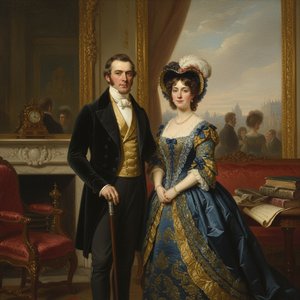
The Quiet Hand of Kraków
In the winding streets of Kraków, a city where history settles heavily upon the cobblestones, Jan Pfeifer lived and worked during a transformative era. He was a painter who understood the weight of a gaze and the dignity of a sitter. His life, though much of it remains shrouded in the soft shadows of the past, found its most enduring expression in the quiet intimacy of portraiture. He did not seek to overwhelm the viewer with grand spectacles, but rather to capture the essence of the individuals who crossed his path, preserving their likenesses through the careful application of oil on canvas.
His presence in the artistic landscape of Poland was marked by a commitment to the human form. He moved through a world of shifting borders and changing social orders, yet his focus remained fixed on the character of his subjects. This dedication to the individual allowed him to navigate the expectations of his time, securing his place among the practitioners of his craft in the early nineteenth century.
A Study in Character
The work that survives to tell his story reveals a man deeply attuned to the nuances of light and the textures of social standing. His brushwork was not a tool for abstraction, but a means to render the reality of a person's station and spirit. One can see this clearly in his most significant surviving contribution to the art of the era.
- The portrait of a woman of high standing, identified as the wife of a general, painted in 1812.
- A work held within the National Museum in Warsaw, showcasing his command of the oil medium.
In this 1812 portrait of Generaless Dziekońska, Pfeifer demonstrates a mastery of the portrait genre. He captures not merely a face, but the very atmosphere of the subject's life. The dimensions of his work, standing nearly a meter in height, allow for a presence that commands attention without demanding it. He used the medium of oil to build layers of color, creating a sense of depth that brings the subject into the room with the observer.
The Legacy of the Portraitist
Though his life reached its end in Kraków in 1814, the traces of his hand remain. He belonged to a tradition where the portrait was a vital record of identity and lineage. His ability to translate the likeness of the Polish nobility into a permanent visual form ensured that his skill would not be forgotten by history. He remains a figure of quiet importance, a painter who looked closely at the people of his time and held their likenesses steady against the passage of years.
Q&A
특정 매체로 분류된 Jan Pfeifer의 모든 작품을 어떻게 찾을 수 있나요?
모든 매체별 페이지에서는 Jan Pfeifer의 작품을 기법별로 모아볼 수 있습니다.
Jan Pfeifer의 작품들은 어떤 분위기를 담고 있나요?
Jan Pfeifer의 작품은 각 작품이 지닌 분위기에 따라 분류된 무드 룸 페이지에서 무드별로 감상하실 수 있습니다.
Jan Pfeifer의 활동 시기는 어떻게 구분되어 있나요?
Jan Pfeifer의 작품 세계를 시간순으로 정리한 기록은 아티스트 연대기 페이지에서 확인하실 수 있으며, 이곳에서는 각 시기별로 분류된 챕터를 따라 작품들을 제작 순서대로 만나보실 수 있습니다.
Jan Pfeifer 작품의 연도별 타임라인이 있나요?
Jan Pfeifer의 작품은 작품 연대기 페이지에서 연도순으로 확인하실 수 있습니다.