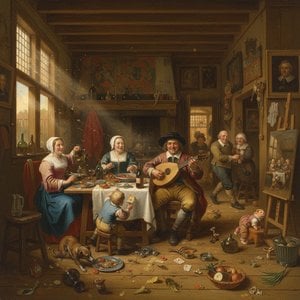
The Legacy of Jan Hals: A Son of the Golden Age
In the vibrant, bustling streets of seventeenth-century Haarlem, a city then basking in the luminous glow of the Dutch Golden Age, Jan Hals emerged as a figure deeply entwined with the very fabric of artistic excellence. Born in 1620, Hals was not merely a witness to the era's prosperity but a direct descendant of its most profound creative spirit. As the son of the legendary master Frans Hals, Jan grew up within the intimate atmosphere of a workshop where the scent of oil paint and the rhythmic movement of the brush were daily companions. Like his brothers Harmen and Frans II, Jan was nurtured in an environment that celebrated both the precision of painting and the soulfulness of music, developing a multifaceted talent that mirrored the Renaissance ideal of the polymath.
His life and identity were inextricably linked to the prestigious Haarlem Guild of St. Luke, an institution that served as the heartbeat of the local art community. To be a member of such a guild was to be part of a lineage of excellence, a commitment to the craft that demanded both technical mastery and a deep understanding of the evolving tastes of the Dutch burgher class. While history often remembers the patriarch Frans Hals for his revolutionary, loose brushwork, Jan Hals represents the continuation of this artistic vitality, carrying forward the traditions of a family that defined the visual language of an entire nation.
Artistic Development and the Haarlem Tradition
The development of Jan Hals's artistry was shaped by the unique pressures and opportunities present in the Netherlands during the mid-1600s. The Dutch market, driven by a burgeoning middle class eager to adorn their homes with scenes of prosperity and virtue, provided a fertile ground for painters who could capture the essence of everyday life. Growing up under the shadow of his father's monumental achievements, Jan was undoubtedly influenced by the alla prima technique and the expressive, spontaneous energy that characterized the Haarlem school. This period in art history moved away from grand religious narratives toward a more intimate exploration of character, portraiture, and genre scenes.
Though much of his individual output remains a subject of scholarly investigation, the essence of his training is evident in the cultural context of his era. The artistic landscape of Haarlem was one of intense competition and innovation, where painters sought to capture the play of light on fabric, the subtle textures of skin, and the profound psychological depth of their subjects. Jan's ability to navigate these complexities suggests a painter who possessed not only the technical skill inherited from his lineage but also the sensitivity required to participate in the sophisticated dialogue of the Dutch Baroque.
A Life Defined by Lineage and Loss
The biography of Jan Hals is as much a story of familial connection as it is of individual achievement. His life was marked by the profound influence of his father's reputation, which provided both a foundation and a formidable standard to meet. The historical records, particularly those of the chronicler Houbraken, offer glimpses into a life that was deeply rooted in the social structures of Haarlem. Jan’s personal history, including his children Jan Jansz and Klaas, reflects the continuity of the Dutch painterly tradition across generations.
However, the brevity of his life—concluding in 1654 at the age of only thirty-four—serves as a poignant reminder of the fragility of even the most promising lives during this era. Despite his relatively short career, Jan Hals remains a significant figure for understanding the interconnectedness of the Dutch Golden Age families. His existence highlights how artistic talent was often a hereditary gift, passed down through workshops to ensure that the brilliance of masters like Frans Hals would continue to illuminate the canvases of the Netherlands long after the masters themselves had laid down their brushes.