The Color of Space
Born in Antwerp in 1891, Jan Cockx began his artistic training at the Antwerp Royal Academy of Fine Arts, a path that would be abruptly interrupted by the onset of World War I. This conflict delayed the emergence of a career that was already beginning to take shape. When he finally held his first exhibition in Paris in 1920, he arrived not as a traditionalist, but as an artist interested in the weight and power of color. He favored large-scale canvases, using them to transform simple subjects into something far more intense through a deliberate flattening of perspective.
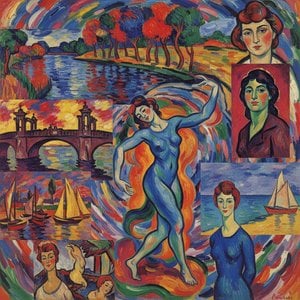
His approach to composition relied on a specific tension between form and hue. Rather than using light and shadow to create depth, he used color to define space. This method often resulted in a distortion of form that felt both modern and raw. His work moved away from the meticulous realism of previous generations, opting instead for a directness that prioritized the emotional impact of the palette over the accuracy of the line.
A Diverse Practice
While he is most frequently associated with the canvas, Cockx’s creative curiosity extended into various mediums. His output was not limited to the singular pursuit of painting, as he sought to apply his visual language to different textures and formats. His interests included:
- Landscapes and harbor scenes
- Still life compositions
- Ceramics
- Graphics and illustrations for the art magazine group Ça ira
This versatility allowed him to experiment with how color behaved on different surfaces, from the matte finish of a graphic print to the three-dimensional curves of a ceramic piece. His exhibitions followed a steady progression through major European centers, including Antwerp, Geneva, Maastricht, and Lyon.
The Fauve Influence
The visual language of Cockx bears the unmistakable mark of the Post-Impressionist and Fauve movements. He drew strength from the works of Matisse and Gauguin, adopting their use of pure, strong colors to strip away unnecessary detail. This influence is most visible in his landscapes and harbor scenes, where the natural world is distilled into its most essential, colorful components. He did not seek to replicate the world as it appeared to the eye, but rather as it could be felt through the application of pigment.
By the time of his death in 1976, Cockx had established a body of work defined by this refusal to adhere to traditional depth. His legacy remains tied to that specific Belgian tradition of bold, expressive color, where the subject matter serves as a vessel for the energy of the paint itself.
Q&A
Jan Cockx의 출생지와 출생 연도는 어떻게 되나요?
Jan Cockx은(는) 1891년 Antwerp에서 태어났습니다.