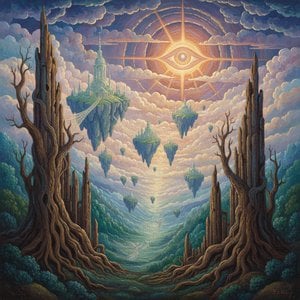
The Quiet Observer of the Urban Form
Ilmar Ojalo’s life was shaped by the shifting borders and heavy silences of the mid-twentieth century. Born in 1910 in Simitica, his early years were marked by a movement through various centers of learning and technical study. He spent time at the Technical University of Tallinn and later at the Prague Polytechnic University until 1936. This technical foundation provided a structural lens through which he would eventually view the world. His hands were trained in the precision of engineering before they were applied to the softer, more intuitive demands of the Art School in Helsinki.
His early exhibitions in Finland and Estonia during the late 1930s and 1940s revealed a mind preoccupied with the way space is occupied. He did not merely look at buildings; he looked at the way they sat within the light and the air. This period of his life was interrupted by the harsh realities of political upheaval. His decision to produce cartoons during the Nazi occupation led to his incarceration in the Vyazalemmskaya colony between 1951 and 1955. This period of confinement is a heavy shadow in his biography, a time when the act of creation became a matter of survival and consequence.
A Life of Restoration and Transition
After his release in 1955, Ojalo returned to the practicalities of preserving what already existed. He worked as a restorer in a Tallinn workshop and previously at the Tartu Art Museum. These years were spent in close contact with the physical substance of art, understanding the chemistry of pigments and the decay of surfaces. His interests eventually expanded beyond the canvas, moving into the structured realms of architecture and design by 1961. He was a man of many layers, moving between the visual and the cerebral.
His intellectual pursuits were as varied as his professional roles:
- The study of urban landscapes and their compositions.
- The investigation of the relationship between sound and color.
- The exploration of psychological phenomena as a member of the Psychological Society of the Soviet Union.
- The teaching of design and architectural principles.
The Geometry of the City
The works that remain from his career often focus on the urban landscape. These pieces are characterized by succinct compositions and a specific way of handling motifs. He was interested in the "music of color," a concept he explored in his writing, suggesting that visual elements possess a rhythmic, auditory quality. His work is not about the grandiosity of a city, but about the specific, quiet geometry of its streets and the way light defines a corner or a facade. He looked at the world with the eye of a technician and the soul of a man who understood the weight of silence.
Q&A
Ilmar Ojalo의 연도별 활동 기록이 있나요?
Ilmar Ojalo의 연대기는 작가의 활동 시기별로 분류된 작품들을 연대순으로 보여주는 스크롤 방식의 타임라인입니다.
Ilmar Ojalo의 작품을 기법별로 모아볼 수 있는 곳은 어디인가요?
특정 매체로 제작된 Ilmar Ojalo의 모든 작품을 확인하시려면, 작가의 모든 매체별 페이지를 이용해 주세요.
Ilmar Ojalo의 작품들은 어떤 분위기를 담고 있나요?
Ilmar Ojalo의 작품은 각 작품이 지닌 분위기에 따라 분류된 무드 룸 페이지에서 무드별로 감상하실 수 있습니다.
Ilmar Ojalo의 작품을 색상별로 모아둔 곳은 어디인가요?
Ilmar Ojalo의 컬러 인덱스에서는 작가의 작품들을 색상별로 모아 보실 수 있습니다.