A Life of Versatile Form
Huibert Marie Luns entered the world in Paris on 6 June 1881, though his roots and eventual destiny remained firmly planted in the Netherlands. The son of a sculptor, he was raised in an environment where the tactile nature of art was a daily presence. His early training began under the guidance of the brothers Antoon and Theo Molkenboer, providing him with a technical foundation that would support a career spanning many disciplines. He later refined these skills at the Rijksnormaalschool for arts and crafts in Amsterdam and through an internship at the Rijksakademie.
His artistic path was never singular. While he is often remembered for his paintings, Luns moved with ease between the roles of sculptor, draftsman, lithographer, and even medal maker. He possessed a particular talent for graphic design, applying his eye to book covers and posters that utilized Art Nouveau decorative principles. This ability to navigate both fine art and applied design allowed him to remain active across various facets of the Dutch visual landscape.
The Academy and the Brush
Luns’s professional life was marked by a deep commitment to art education, often holding significant administrative responsibilities alongside his creative practice. He served as a teacher at the Rotterdam Academy from 1908 to 1917 and later directed the Academy of 's-Hertogenbosch between 1917 and 1923. His influence on the next generation of artists was solidified through his leadership at the Rijksinstituut voor Opleiding van Tekenleraren in Amsterdam and his tenure as a professor at the Delft University of Technology from 1931 until his death in 1942.
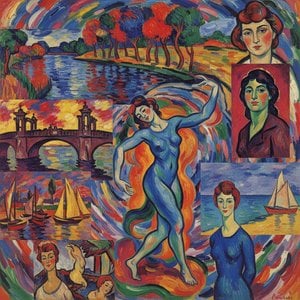
In his studio, his style reflected the shifting currents of his era. His work moved between the realism of his early teachers and the more fluid, loose palettes of Impressionism and Post-Impressionism. He was also associated with Luminism, a style that emphasized the play of light. His subject matter was as varied as his training:
- Portraits of prominent Dutch figures and social elites.
- Nude studies demonstrating academic precision.
- Elegant women set within sun-drenched landscapes.
- Still lifes, cityscapes, and beach scenes captured during his travels.
A Final Chapter in Amsterdam
Beyond the canvas, Luns was a man of letters, publishing books on Dutch painting and writing travel guides such as the Ten walks in... series. His intellectual pursuits were matched by his civic contributions, including the creation of a statue in Maastricht to honor French refugees from the First World War. He was a respected member of several art associations, including Arti et Amicitiae and Sint Lucas, and received the Order of Orange-Nassau in 1930.
The end of his life came in Amsterdam on 24 February 1942. He left behind a body of work that captured the light and atmosphere of the early twentieth century, as well as a family legacy that extended into international diplomacy through his son, Joseph Luns. His paintings remain held in significant collections, such as the Rijksmuseum and Museum Rotterdam, preserving the record of a man who lived at the intersection of art, education, and design.