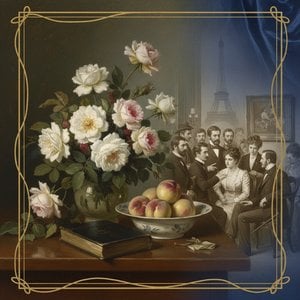
A life in lines and light
Henry Thue began his path far from the easel, trained initially as an engineer at the Kristiania tekniske skole. It was only in 1914 that he turned toward the study of art, moving through the academies of Weimar and Copenhagen before finding his way to the Statens Kunstakademi in Christiania under the guidance of Chr. Krohg. His hands, once accustomed to the precision of technical drawing, learned the softer demands of oil painting, etching, and lithography.
His movements followed a quiet trajectory through Europe. He spent time in Germany and Denmark before settling in Paris from 1919 onwards. These travels brought different textures to his work, yet he maintained a focus on naturalistic forms. His use of color remained cautious, never seeking to overwhelm the eye, but rather to settle into the subject at hand.
The subjects of the studio
The work left behind by Thue captures the stillness of specific moments. He looked closely at landscapes, portraits, and still lifes, often working with a restrained palette. In his graphic works, such as his etchings and engravings, there is a clear attention to the weight of a line. His self-portrait, painted before 1917, shows a man observing his own likeness with the same steady gaze he applied to the world around him.
Some of his pieces carry the marks of his time in France, such as his 1920 oil painting titled I tankar, which bears the notation of Paris. His graphic output also included contributions to collections like the Årsmappe Norsk Forening for Grafisk Kunst, featuring works like Mannshode. The subjects he chose—a horse in the woods or a quiet figure—were rendered with an emphasis on form rather than dramatic flair.
A legacy in Norwegian collections
Though his life ended in Nice in 1921, his presence remains in several established Norwegian institutions. His graphic works can be found in the Nasjonalgalleriet in Oslo, while his paintings are held within the Oslo Bymuseum and the Bergen Billedgalleri. These pieces represent a period of transition in Norwegian art, where the technical discipline of his early training met the naturalistic traditions of his mentors.
His professional life was marked by memberships in groups such as Foreningen Norske Grafikere and participation in exhibitions like Høstutstillingen between 1916 and 1919. Even in the small, detailed etchings and lithographs that surfaced in later years, one sees the same careful approach to light and shape that defined his brief career.
Q&A
특정 색상 팔레트의 Henry Thue 작품은 어디에서 찾아볼 수 있나요?
컬러 팔레트별로 보기 페이지에서는 Henry Thue의 작품들을 색상 팔레트별로 모아볼 수 있습니다.
Henry Thue의 작품 중 몇 점을 둘러보실 수 있나요?
전체 작품 보기 페이지에서 Henry Thue의 작품 작품 1점점을 만나보실 수 있습니다.
Henry Thue은(는) 어느 시대의 작품을 남겼나요?
Henry Thue은(는) Modern 시대에 활동했습니다. 이 시기는 역사적 맥락 속에서 작가의 예술적 위치를 보여줍니다.
Henry Thue의 출생지와 출생 연도는 어떻게 되나요?
Henry Thue은(는) 1890년 Christiania에서 태어났습니다.