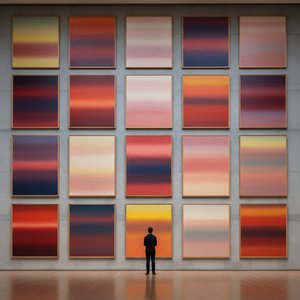
The Abstract Vision of Henry C. Pearson
In the vibrant tapestry of twentieth-century American modernism, few artists navigated the intersection of precision and spontaneity as gracefully as Henry C. Pearson. Born on October 8, 1914, in Kinston, North Carolina, Pearson’s journey was one defined by a profound synthesis of diverse global influences. His early academic foundations at the University of North Carolina and his subsequent studies in theatrical design at Yale University provided him with a unique structural understanding of space and composition. This background in design would later become a cornerstone of his visual language, allowing him to balance the rigorous geometry of hard-edged abstraction with a sense of whimsical movement.
The trajectory of Pearson’s life was irrevocably altered by the Second World War. Serving in the U.S. Army Air Corps, he was tasked with the meticulous creation of maps for the Okinawa campaign. This period of service introduced him to a world where cartography and art converged; the precision required for topographical accuracy began to seep into his creative consciousness. Following the war, his re-enlistment during the occupation of Japan opened a window into an entirely different aesthetic realm. Immersed in the subtle nuances of Japanese art and theatre forms, Pearson developed an appreciation for minimalism and the evocative power of negative space, elements that would later breathe life into his abstract compositions.
A Synthesis of Style and Movement
Upon settling in New York in the early 1950s, Pearson entered a period of intense artistic maturation. Studying at the Art Students League under masters such as Reginald Marsh and Will Barnet, he became part of a burgeoning community of innovators. His work began to reflect a fascinating tension between various modernist currents. While he was loosely associated with the Op Art movement—notably participating in the landmark Responsive Eye exhibition at the Museum of Modern Art in 1965—his true essence lay in a more personal, eclectic exploration. He drew inspiration from the structural purity of Piet Mondrian and the spiritual abstraction of Kasimir Malevich, yet he infused his work with a distinctively human touch.
Pearson’s oeuvre is celebrated for its remarkable versatility, ranging from abstract, multi-colored globes to 'stochastic' or chance-generated paintings that explore the beauty of randomness. His technical repertoire was equally broad, encompassing:
- Hard-edged abstraction: Utilizing clean lines and precise boundaries to create structured, geometric compositions.
- Lithography: Demonstrating a mastery of printmaking through works like Nuee Rouge Violet, where intricate patterns and bold color blends emerge.
- Textural exploration: Creating depth through subtle washes and layered surfaces that evoke atmospheric qualities.
- Sculptural influence: Developing paintings modeled after the rhythmic forms of Dogon sculpture from West Africa.
Legacy and Lasting Significance
Beyond the canvas, Pearson was a man of deep intellectual curiosity, finding profound connections between visual art and literature. His passion for the written word led him to illustrate several poems by the Nobel Prize-winning Irish poet Seamus Heaney, a collaboration that mirrored his own ability to translate linguistic emotion into visual form. This intersection of disciplines highlights the holistic nature of his creative spirit—a spirit that sought meaning not just in shapes and colors, but in the very essence of storytelling.
Today, the legacy of Henry C. Pearson resides in some of the world's most prestigious institutions, ensuring that his contributions to modernism continue to inspire new generations of viewers. His work serves as a testament to the power of an open mind, proving that an artist can find harmony between the rigid lines of a map and the fluid emotions of a color wash. His permanent collections include:
- The Metropolitan Museum of Art
- The Museum of Modern Art (MoMA)
- The Smithsonian American Art Museum
- The North Carolina Museum of Art
Through his ability to weave together the influences of American, Japanese, and African aesthetics, Pearson remains a pivotal figure in the history of abstract art, leaving behind a body of work that is as intellectually stimulating as it is visually captivating.
질의응답
Henry Pearson의 작품을 색상별로 모아둔 곳은 어디인가요?
색상별 인덱스 페이지에서는 Henry Pearson의 작품들을 색상별로 모아 보실 수 있습니다.
Henry Pearson의 작품 세계는 시간이 흐름에 따라 어떻게 변화했나요?
Henry Pearson의 예술적 여정은 연대기 페이지에서 시기별로 펼쳐집니다. 이곳에서는 작가의 활동 시기를 장(chapter)으로 나누어 작품들을 연대순 타임라인 형태로 한눈에 확인할 수 있습니다.
미술 사조별로 분류된 Henry Pearson의 작품은 어디에서 볼 수 있나요?
Henry Pearson의 작품은 작가의 모든 사조 페이지에서 사조별로 둘러보실 수 있습니다.
Henry Pearson의 작품 중 몇 점을 둘러보실 수 있나요?
모든 작품 보기 페이지에서 Henry Pearson의 작품 작품 7점점을 만나보실 수 있습니다.
Henry Pearson가 그린 모든 주제를 한눈에 볼 수 있는 개요가 있나요?
주제별 아틀라스 페이지에서는 Henry Pearson의 작품들을 주제별로 찾아보실 수 있습니다.
키워드로 Henry Pearson의 작품을 찾아볼 수 있나요?
Henry Pearson의 작품은 아티스트의 키워드별로 페이지에서 키워드별로 찾아보실 수 있습니다. 각 키워드는 관련 작품들을 그룹화하여 보여줍니다.
Henry Pearson 작가의 작품을 감상할 수 있는 가상 박물관에 방문할 수 있나요?
Henry Pearson의 3D 뮤지엄는 작가의 작품들을 가상 3D 갤러리로 선보이는 페이지입니다.
특정 팔레트의 Henry Pearson 작품은 어떻게 찾을 수 있나요?
특정 색상 팔레트의 Henry Pearson 작품을 찾으시려면, 작가의 컬러 팔레트별 페이지를 이용해 보세요.