A Life Between Two Lands
Born in Roermond, Netherlands, Jan Hendrik Luyten carried the spirit of his Dutch roots even as he became a naturalized Belgian. His early years were shaped by the traditions of his father, Francis Hubert Luyten, and the quiet landscapes of his birthplace. Seeking to refine his vision, he traveled to Antwerp to study at the Royal Academy of Fine Arts, later finding himself in Paris at the Ecole des Beaux-Arts under the guidance of Alexander Cabanet. These formative years in the great art centers of Europe allowed him to absorb the light and technique of the era.
The artist's path was never a simple ascent. He found himself deeply moved by the harsh realities of the Borinage, a coalmining region in southern Belgium. During the years between 1886 and 1887, he witnessed the heavy toll of labor and the bloody suppression of strikes. This period of observation left an indelible mark on his soul, leading him to dedicate years to a massive triptych titled The Strike, also known as Struggle for Life. Through these panels, such as Misery and After the uprising, he translated the suffering of the working class into a profound visual language.
Artistic Vision and Influence
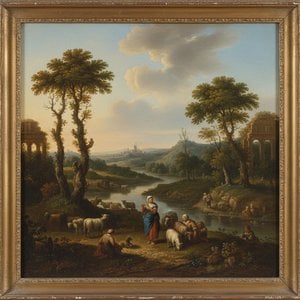
Luyten possessed a versatile hand that could shift from the delicate details of a portrait to the sweeping breadth of a marine scene. His style drew strength from several distinct traditions. He looked back toward the 17th-century Dutch and Flemish masters, finding inspiration in their command of composition. At the same time, he embraced the more modern sensibilities of the Hague School, the Barbizon school, and Impressionism. This blend allowed him to capture both the historical weight of his subjects and the fleeting qualities of natural light.
His interests were wide-ranging, encompassing:
- Genre scenes that depicted the daily lives of common people.
- Landscapes that reflected the changing seasons and terrains of Europe.
- Animalist works focusing on the character of creatures in nature.
- Portraits that sought to capture the essence of his sitters.
The Later Years and Legacy
Life brought both professional honors and personal hardship to Luyten. While he earned a Gold Medal from the Rijksmuseum in Amsterdam in 1886, later years were clouded by political tension. Following World War I, his perceived stance regarding the Dutchification of Ghent University led to a boycott by the Belgian establishment. This period of isolation forced him and his second wife, Hedwich Behnisch, to seek refuge in northern Germany near the Baltic Sea. He eventually returned to Brasschaat, where he established the Institut des Beaux Arts Henry Luyden, teaching students from across Europe and the United States.
Despite the difficulties of his final years, including the loss of his son and the hardships of World War II, his commitment to his craft remained. He left behind a body of work that includes significant pieces like The Golden Canvass of Flanders, a monumental work depicting figures from Flemish history. His life ended in 1945, shortly after facing the trials of wartime imprisonment, leaving a legacy preserved in institutions such as the Municipal Museum Hendrik Luyten-Dr. Cuypers.
Q&A
Henry Luyten 작가 작품의 컬러 프로필은 어디에서 확인할 수 있나요?
이 사이트에 등록된 작품 전반에 나타나는 Henry Luyten의 색채 활용은 작가의 팔레트 지놈 페이지에서 자세히 살펴보실 수 있습니다.
Henry Luyten가 그린 모든 주제를 한눈에 볼 수 있는 개요가 있나요?
Henry Luyten의 주제별 작품 모음는 작가의 작품들을 주제별로 찾아볼 수 있는 페이지입니다.
키워드로 Henry Luyten의 작품을 찾아볼 수 있나요?
특정 주제의 Henry Luyten 작품을 찾으려면 키워드별로 작품이 분류된 작가의 키워드별 탐색 페이지를 이용해 보세요.