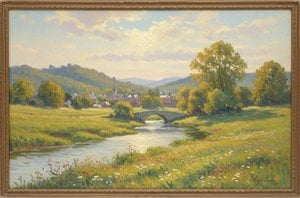
The Quiet Observer of the WPA Era
Harold Black lived a life shaped by the steady rhythms of mid-century American art. Born in New York City, he spent his formative years absorbing the visual language of the city before refining his hand at the National Academy of Design. His work was not a solitary pursuit; he shared a life and a studio with Isabel Bate, a fellow artist. Together, they moved through the creative circles of New York, their lives intertwined by the shared labor of making art during a period of significant national change.
His hands were busy with the demands of the Works Progress Administration. This era called for artists to step away from the private canvas and engage with the public space. Black responded to these calls, focusing on the way light and form interacted with the human figure and the landscape. His presence in the 1940 Museum of Modern Art exhibition, titled The Artist as Reporter, placed his perspective among those documenting the pulse of a nation in flux.
A Record of Form and Light
The work Black produced often sought to capture a specific sense of place and presence. His involvement in large-scale commissions showed a capacity for thinking in terms of architecture and communal space. Even when the intended destination for a work was lost to history, the effort remained a part of his professional identity. His output during this time included several distinct types of creative labor:
- The creation of eight murals intended for the U.S. Post Office in Salina, Kansas.
- Illustrations for the 1941 book The Kaw: The Heart of a Nation.
- Paintings that explored the interplay of light and shadow, such as Sunbath.
In pieces like Sunbath, there is a focus on the physical reality of the subject. He did not look for grand gestures, but rather for the way a body occupies space under the sun. His brushwork was a tool for recording these moments, a way to pin down the fleeting quality of light before it shifted.
The Later Years and Legacy
Black’s trajectory eventually led him away from the bustling streets of New York. He spent his final years in Mexico City, a city with its own deep, heavy light and different textures of life. He died there in 1993, leaving behind a body of work that remains held in significant institutions, including the Smithsonian American Art Museum. His paintings are not loud, but they persist as quiet records of a specific American moment, captured by a man who watched the world with a steady, unhurried eye.
Q&A
Harold Black의 작품을 팔레트별로 모아둔 곳은 어디인가요?
Harold Black의 작품은 작가의 컬러 팔레트별로 보기 페이지에서 컬러 팔레트별로 만나보실 수 있습니다.
Harold Black의 출생지와 출생 연도는 어떻게 되나요?
Harold Black은(는) 1913년 New York City에서 태어났습니다.
Harold Black 작가 작품의 컬러 프로필은 어디에서 확인할 수 있나요?
Harold Black의 팔레트 지놈에서는 작가의 작품 세계를 구성하는 컬러 프로필을 확인하실 수 있습니다.
Harold Black의 작품을 매체별로 찾아볼 수 있나요?
Harold Black의 작품은 작가 페이지인 모든 매체별에서 매체별로 둘러보실 수 있습니다.