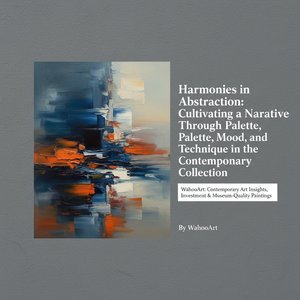
Hans Moller: The Architect of Color
Born in Wuppertal, Germany, in 1905, Hans Moller’s life was a testament to resilience and an unwavering pursuit of visual expression. His early years were marked by the familiar rhythms of a working-class upbringing – bricklaying provided a grounding reality before he found his true calling within the burgeoning world of art. Initially trained as an instructor at the Kunstgewerbeschule Wuppertal-Barmen, Moller’s artistic inclinations quickly outgrew the confines of craft instruction, leading him to pursue formal studies at the Academy of Fine Arts in Berlin. This period laid the foundation for his distinctive style, a bold departure from prevailing trends and a profound exploration of color as both subject and method.
The shadow of rising fascism forced Moller’s hand in 1936; he fled Germany with his Jewish wife, Helen Rosenblum, seeking refuge in America. This pivotal moment dramatically altered the trajectory of his career. Initially finding work as a graphic designer for the advertising firm Lord and Thomas, Moller quickly recognized the limitations of commercial art and began to dedicate himself fully to painting. It was during this time that he discovered the vibrant energy of New York’s Surrealist scene, an encounter that would profoundly influence his artistic vision. The American landscape, with its vast skies and shifting light, became a constant source of inspiration, fueling his desire to capture the essence of color in its purest form.
The Colorist's Palette
Moller’s artistic philosophy centered around an almost spiritual connection to color. He famously stated, “I only want to wake up every day and decide what colors to paint my sky.” This simple declaration encapsulates the core of his practice – a deliberate and intuitive exploration of hue, saturation, and value. Unlike many abstract artists who sought to represent form through color, Moller used color as the primary subject matter, creating luminous fields of vibrant tones that seemed to pulse with an inner light. His work eschewed traditional compositional structures, favoring instead a sense of spontaneity and immediacy. This approach resulted in paintings that are both deeply personal and universally resonant.
His technique was characterized by layers of thin washes applied to large canvases, allowing the colors to bleed and mingle organically. Moller often employed a pointillist-inspired method, meticulously applying small dots of color to build up complex textures and shimmering effects. This layering process created an illusion of depth and movement, as if the paintings were constantly shifting and evolving before the viewer’s eyes. The influence of Fauvism is evident in his bold use of color, but Moller's work transcends mere imitation, forging a unique and intensely individual style.
A Retrospective Journey
Moller’s career spanned nearly six decades, during which he exhibited extensively throughout the United States. His early exhibitions at galleries like Bonestell in New York City garnered critical attention, establishing him as a rising star within the American art scene. Throughout the 1940s and 1950s, his work was showcased alongside that of prominent figures such as Mark Rothko and Milton Avery, further solidifying his position as a significant voice in abstract expressionism. Despite this recognition, Moller remained largely unheralded during his lifetime, often overshadowed by more commercially successful artists.
In 1995, a retrospective exhibition at the Lore Degenstein Gallery in Dusseldorf marked a turning point in his career, bringing him to the attention of a wider German audience. This event was followed by a comprehensive survey of his work at the Susquehanna University Museum in 2001-2002, which traveled to the Portland Art Museum in Maine. These exhibitions served as a testament to Moller’s enduring legacy and demonstrated the profound depth and complexity of his artistic vision. His works are now held by prestigious institutions including the Museum of Modern Art, the Whitney Museum of American Art, and the Allentown Art Museum.
Legacy and Influence
Hans Moller's impact on 20th-century art extends far beyond his individual creations. He demonstrated the transformative power of color as a primary artistic language, challenging conventional notions of representation and paving the way for future generations of abstract painters. His emphasis on intuition and spontaneity encouraged artists to embrace their own unique perspectives and to explore the emotional resonance of color in new and innovative ways. As Rachel Ward Sepielli noted in Cooper Hewitt’s 2017 exhibition “A Magical Era,” Moller's work embodies a "whimsical" quality, reminding us of the beauty found in simple forms and vibrant hues.
Moller died peacefully in Allentown, Pennsylvania, in October 1997, leaving behind a body of work that continues to captivate and inspire. His paintings are not merely visual objects; they are invitations to experience the world through a prism of color, a testament to the enduring power of artistic vision.
Q&A
Hans Moller 작가 작품의 컬러 프로필은 어디에서 확인할 수 있나요?
Hans Moller 작가 작품의 컬러 프로필은 작가의 팔레트 지놈 페이지에서 확인하실 수 있습니다.
Hans Moller 작가의 다른 활동명이나 알려진 이름이 있나요?
Hans Moller은(는) هانس مولر(으)로도 알려져 있습니다.
특정 주제별로 Hans Moller의 작품을 어떻게 찾아볼 수 있나요?
Hans Moller의 키워드별 탐색 페이지에서는 작가의 작품들을 키워드별로 모아볼 수 있습니다.
Hans Moller의 작품을 색상별로 정렬해서 볼 수 있나요?
Hans Moller의 작품은 작가의 컬러 인덱스 페이지에서 색상별로 감상하실 수 있습니다.