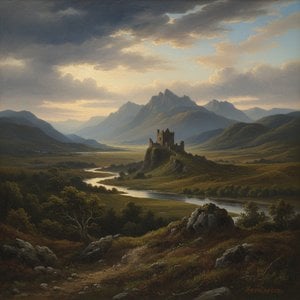
A Life of Color and Paper
Born in Leith, Scotland, Hans Jacob Hansen lived a life defined by the fluid boundaries of his medium. As a painter of Danish descent, he found his footing in Edinburgh, studying under R. B. Nisbet and J. Ross. His approach to the canvas was far from traditional. He favored a technique where colors were allowed to run together upon wet paper, a method that required both a steady hand and an acceptance of chance. Details emerged only as the paper dried, leaving behind scenes that felt as much like captured moments as they did deliberate compositions.
His interests led him far from the Scottish coast. Hansen traveled extensively through the Middle East, North Africa, and Spain. These travels provided the subject matter for his most noted works, which focused on the atmosphere of Eastern markets, the quietude of harems, and the intensity of bullfighting scenes. He possessed a particular talent for capturing the light and movement of these distant locales.
Recognition and Membership
The progress of his career was marked by steady institutional recognition. His work reached audiences at the Royal Academy and the Royal Scottish Academy, places where his specific style could be observed by his peers. In 1906, he achieved a significant milestone when he was elected a member of the Royal Scottish Watercolour Society.
His ability to translate foreign landscapes into watercolor earned him honors on the international stage as well. At the Salzburg International Exhibition, he was awarded a silver medal, a distinction that reflected the technical skill required for his wet-paper method. His life eventually brought him to Southend-on-Sea, England, where he passed away in 1947.
Q&A
Hans Hansen의 작품을 분위기별로 찾아볼 수 있나요?
Hans Hansen의 작품은 각 작품이 지닌 분위기에 따라 분류된 무드 룸 페이지에서 무드별로 감상하실 수 있습니다.
Hans Hansen 작가 작품의 컬러 프로필은 어디에서 확인할 수 있나요?
Hans Hansen의 팔레트 지놈에서는 작가의 작품 세계를 구성하는 컬러 프로필을 확인하실 수 있습니다.
Hans Hansen은(는) 어느 시대의 작품을 남겼나요?
Hans Hansen은(는) Early Modern 시대에 활동했습니다. 이 시기는 역사적 맥락 속에서 작가의 예술적 위치를 보여줍니다.