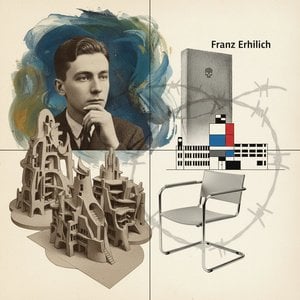
The Architect of Social Necessity: The Visionary Life of Hans Emil Meyer
In the grand tapestry of twentieth-century modernism, few figures loom as provocatively as Hans Emil Meyer, known more intimately to history as Hannes Meyer. Born in Basel, Switzerland, in 1889, Meyer did not merely seek to design buildings; he sought to engineer a new way of living. His journey began far from the abstract geometries of high modernism, rooted in the tactile reality of masonry and the rigorous academic halls of Munich and Dresden. This foundational connection to the physical substance of construction—the very grit and mortar of the earth—would later inform his radical belief that architecture must be stripped of all vanity to serve the fundamental needs of the human collective.
Meyer’s ascent into the vanguard of architectural thought was inextricably linked to his tenure at the Bauhaus. Appointed as the second director of the Dessau school between 1928 and 1930, he brought a revolutionary, almost clinical, functionalism to the institution. While his predecessor, Walter Gropius, had balanced artistry with industry, Meyer pushed the boundaries toward a pure, uncompromising social utility. He famously dismissed the pursuit of "art for art's sake," instead championing a philosophy where the only true motives for building were the biological and social requirements of the inhabitants: hygiene, sunlight, nutrition, and economic efficiency. To Meyer, a house was not a canvas for aesthetic expression but a highly optimized machine for living.
A Legacy of Constructivism and Global Impact
The trajectory of Meyer’s career was as turbulent as the political landscape of the interwar period. His radicalism—often leaning toward the collectivist ideals of Constructivism—eventually led to a fracture with the more conservative elements of the Bauhaus board, resulting in his departure in 1930. Yet, this exile only served to expand his architectural footprint across the globe. From the urban planning strategies he helped shape within the Soviet Union to commissions spanning Germany, Switzerland, and Mexico, Meyer’s influence became truly international. He was a man of movement, navigating the complex intersections of politics, technology, and social reform.
His contributions were not limited to singular structures but extended into the very fabric of urban existence. As an active participant in the Congrès internationaux d’architecture moderne (CIAM), he helped establish the foundational doctrines of modern urban planning. His work on housing estates, such as the "Freidorf" project near Basel, demonstrated his commitment to improving the living conditions of the working class through thoughtful, communal design. Even when his most ambitious projects, like the Geneva League of Nations Building or the Basel Petersschule, remained unbuilt, they stood as monumental blueprints for a future defined by structural steel and light.
Reflecting on his immense historical significance, one finds a legacy characterized by:
- The Radicalization of Functionalism: Moving architecture away from stylistic ornamentation toward a rigorous, science-based approach to human needs.
- Socially Conscious Urbanism: Pioneering housing solutions that addressed the pressing social challenges of the twentieth century through collective planning.
- Interdisciplinary Innovation: Fostering a unique synergy between the roles of the architect, the craftsman, and the industrial technologist.
- Global Modernist Influence: Spreading the principles of Swiss and German modernism to diverse cultural contexts, including the USSR and Latin America.
Though his life ended in 1954 in Lugano, Switzerland, the echoes of Meyer’s uncompromising vision remain embedded in the concrete and steel of our modern cities. He remains a towering figure for anyone who views architecture not as a luxury of the elite, but as a fundamental human right.
Q&A
Hans Emil Meyer의 활동 시기는 어떻게 구분되어 있나요?
Hans Emil Meyer의 연대기는 작가의 활동 시기별로 분류된 작품들을 연대순으로 보여주는 스크롤 방식의 타임라인입니다.
Hans Emil Meyer 작가의 작품을 감상할 수 있는 가상 박물관에 방문할 수 있나요?
Hans Emil Meyer의 작품은 작가의 3D 갤러리 페이지 내 3D 갤러리에서 감상하실 수 있습니다.
Hans Emil Meyer은(는) 어느 시대의 작품을 남겼나요?
Hans Emil Meyer은(는) Modern 시대에 활동했습니다. 이 시기는 역사적 맥락 속에서 작가의 예술적 위치를 보여줍니다.
Hans Emil Meyer의 출생지와 출생 연도는 어떻게 되나요?
Hans Emil Meyer은(는) 1889년 Basel에서 태어났습니다.