Early Life, Family and Training
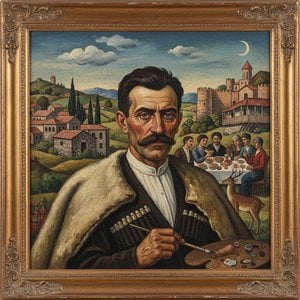
Guros was born in 1905 in the town of Goris, arriving into the Melik Ohanyans family. His lineage was one of intellectual and practical pursuits; his father, Gevorg Paronyan, was a man of considerable learning, often described as a walking encyclopedia, and the family operated various enterprises, including a pharmacy and a bookbinder's shop. Tragedy arrived early in Guros's life. He was only one year old when his father passed away, and by the age of two, he had also lost his mother. He was raised by his aunt, a skilled carpet weaver, who provided the stability necessary for his early years in Goris.
His entry into the visual arts did not follow the traditional path of academic instruction. Guros was a self-taught artist, developing his eye and hand through personal observation rather than formal schooling. This independence of training would define much of his creative development. He did not begin his professional engagement with the lens until he was twenty-two, entering the world of art through photography. This early immersion in capturing the light and landscape of his surroundings provided the foundation for the visual sensibilities he would later bring to the canvas.
Career in Photography and Painting
Guros’s creative life began through the lens of a camera. After spending a decade documenting the landscapes and customs of the Syunik region, he opened an art studio in Goris in 1928. This studio remained a fixture of the local community until 1932. By 1933, his professional focus shifted to Yerevan, where he served as a photographer for the Scientific Research Institute. While his photographic work captured the ethnographic and architectural essence of the Armenian landscape, a different impulse was already taking hold. He began to take up painting in 1931, a pursuit that would eventually demand his full attention.
The transition from capturing light to applying pigment was a deliberate choice. In 1938, Guros gave up photography entirely to dedicate himself to the fine arts. This shift marked the beginning of a significant period of painterly development. His commitment to the medium was recognized by his peers when he became a Member of the Armenian Artists' Union in 1939. His steady progression through the ranks of the Armenian art community culminated in 1965, when he was awarded the title of an Honoured Artist of the Armenian SSR.
- Still Life with Apricots and Cherries (1952)
Artistic Style and Technique
The visual language of Guros was shaped by the enduring influence of classical Armenian painting traditions. His approach to the canvas was marked by a sincere and simple depiction of everyday life, avoiding the heavy-handedness often found in more dramatic works. He possessed a subtle artistic sense that allowed him to capture the materiality of his surroundings through a meticulous attention to detail. Rather than relying on the jarring expressiveness of yellow or abrupt transitions, he sought a more measured harmony. This restraint helped him create gentle relationships between light and form, conveying the living breath of the environments he observed.
His compositions often balanced a sense of grand spectacle with an intimate, grounded perspective. This duality is evident in his ability to render both the vastness of a landscape and the quiet dignity of a domestic scene. He approached his subjects with a focus on the tangible qualities of the world, ensuring that the textures of his subjects felt present and real. His work avoids the artificial, opting instead for a clarity of execution that honors the subject's inherent character.
- Still Life with Apricots and Cherries (1952)
- Untitled (about 1967)
Where to See the Works Today
The visual record of Guros's life and creative output is preserved across several significant institutions in Armenia. The National Gallery of Armenia in Yerevan maintains the largest presence of his work, holding eleven pieces from his various periods. His paintings and photographic studies are also part of the permanent collections at the History Museum of Armenia in Yerevan and the Museum of Local History in Sisian.
Beyond these permanent repositories, his dual legacy as both a painter and a photographer has been brought together for public viewing in specific settings. In 2018, a solo exhibition featuring both his paintings and his photography was held at the Zvartnots historical museum-reserve. These collections offer a way to observe the transition from his early ethnographic documentation to his later, more personal explorations of the Syunik landscape.