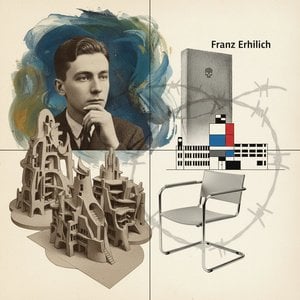
The Architecture of Memory
Born in Magdeburg, East Germany, Gregor Hohenberg grew up amidst the shifting shadows of the GDR. His early years were shaped by a landscape defined by socialist realism and the quiet tension of a changing political order. He witnessed the protests of 1989 and the subsequent transformation of his homeland, an experience that instilled a deep sensitivity to how history settles upon the individual. This background provided more than just a setting; it offered a lens through which to view the intersection of personal identity and the weight of the past.
His formal training at Burgtheater Wien introduced him to the mechanics of light and the art of performance. This period was crucial, as it moved his focus from simple documentation toward a more theatrical approach to the human form. He learned how shadow can define a face and how lighting can suggest a psychological state, a skill that would later define his editorial work. His photographs often feel like staged moments of truth, where the subject is caught in a dialogue with their own history.
A Fusion of Fashion and History
Hohenberg’s professional life has been defined by a refusal to separate the aesthetic from the historical. His work for publications such as Vogue Italia, Harper’s Bazaar, and Elle demonstrates a capacity to blend high fashion with deep cultural inquiry. He does not merely capture a garment; he places it within a context of German heritage, often drawing inspiration from the stark lines of Bauhaus architecture or the emotional intensity of Expressionism. His images frequently explore how modern identity is constructed from the fragments of what came before.
His career is marked by several distinct professional threads:
- Editorial photography for major international publications including Vogue, GQ, and Vanity Fair.
- A long-standing role as Chief Photographer for Achtung, where he explored the nuances of fashion and subculture.
- A deep investigation into German traditional dress, documenting the intricate details of regional costumes.
- Collaborations with diverse commercial clients ranging from Adidas Y3 to various music labels.
This versatility allows him to move between the polished world of high-fashion editorials and the raw, documentary-style exploration of folk traditions. He has shown an interest in the way objects, like the silver buttons or bone ornaments of traditional attire, act as silent communicators of a lost way of life.
The Expressionist Lens
The technical core of his work often relies on the principles of Expressionism. He utilizes distorted perspectives and heightened color palettes to reach beyond the surface of a portrait. This method seeks to capture an inner state rather than a mere likeness. By manipulating the visual field, he emphasizes the psychological tension inherent in his subjects, making the portrait an exploration of the mind as much as the face. His work remains a study in how the camera can be used to interpret emotion rather than simply record it.
Q&A
특정 색상 팔레트의 Gregor Hohenberg 작품은 어디에서 찾아볼 수 있나요?
특정 색상 팔레트의 Gregor Hohenberg 작품을 찾으시려면, 작가의 컬러 팔레트별로 보기 페이지를 이용해 보세요.
Gregor Hohenberg 작가의 국적은 어디인가요?
Gregor Hohenberg은(는) Germany 출신입니다.
Gregor Hohenberg의 출생 도시와 국가는 어디인가요?
Gregor Hohenberg은(는) Germany Magdeburg에서 태어났습니다.
주제별로 Gregor Hohenberg의 작품을 찾아볼 수 있나요?
주제별 작품 모음 페이지에서는 Gregor Hohenberg의 작품들을 주제별로 확인하실 수 있습니다.