The Evolution of an Abstract Expressionist
Gordon Rayner was a Canadian abstract expressionist painter whose creative process was defined by constant innovation and a frequent transformation of his medium. His early training began under his father, a commercial artist, and Jack Bush. Following a period of working in commercial art, Rayner’s direction shifted toward abstraction, influenced by the work of artists such as Willem de Kooning and the exhibitions of Painters Eleven. During the late 1950s and the first half of the 1960s, he began to incorporate found materials into his paintings, a practice influenced by the neo-Dada movement.
In 1966, Rayner entered a period focused on the Magnetawan area, located north of Toronto. These works served as a space for experimentation with technique and materials, allowing him to refer to nature through oblique references and a thick, expressionist technique. His work was exhibited with Toronto's Isaacs Gallery, leading to his association with the Isaacs Group of artists.
Later Shifts and Subject Matter
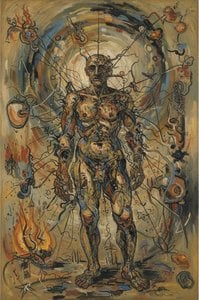
By the 1980s, Rayner’s artistic focus shifted toward the figure. He explored realism in the context of the body, often painting himself in inventive scenes that addressed the spiritual self. This period included the Oaxaca Suite, inspired by his time living in Oaxaca, Mexico, in 1993 and 1994.
Throughout his career, Rayner received various public commissions, including the porcelain enamel on steel mural Tempo for the Toronto Transit Commission's St. Clair Station in 1977. His legacy is held in numerous institutions, including:
Q&A
Gordon Rayner 작품의 연도별 타임라인이 있나요?
Gordon Rayner의 작품을 연도별로 정리하여 보여주는 작품 연대기 페이지입니다.
Gordon Rayner의 출생지와 출생 연도는 어떻게 되나요?
Gordon Rayner은(는) 1935년 Toronto에서 태어났습니다.
Gordon Rayner의 작품을 분위기별로 모아둔 곳은 어디인가요?
Gordon Rayner의 작품은 각 작품이 지닌 분위기에 따라 분류된 무드 룸 페이지에서 무드별로 감상하실 수 있습니다.
Gordon Rayner의 출생 도시와 국가는 어디인가요?
Gordon Rayner은(는) Canada Toronto에서 태어났습니다.