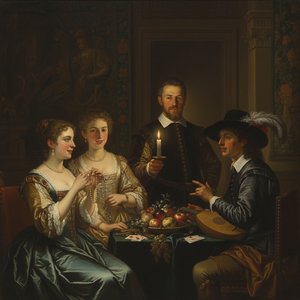
The Grandeur of the Flemish Baroque: The Life of Godfried Maes
In the vibrant, artistic heart of seventeenth-century Antwerp, a period defined by the dramatic interplay of light and shadow, Godfried Maes emerged as a master of the grand narrative. Born in 1649 to a lineage of artists, Maes was steeped in the traditions of the Southern Netherlands from his very first breaths. As the son of the painter Godfried Maes, his apprenticeship began within the intimate confines of his father's studio, where the fundamentals of form and color were etched into his developing mind. This early immersion provided him with a profound technical foundation, which he later refined under the tutelage of the esteemed history painter Pieter van Lint. By 1672, Maes had achieved the prestigious status of master within the Antwerp Guild of Saint Luke, marking the beginning of a career that would see him rise to become the Dean of the Guild in 1682.
Maes’s artistic journey was one of immense scale and profound devotion. He did not merely paint; he constructed worlds of spiritual and mythological significance. His repertoire was vast, ranging from the solemnity of religious altarpieces to the complex, swirling allegories that adorned the ceilings of Europe's most opulent palaces. Whether he was capturing the martyrdom of a saint or the ethereal beauty of a classical myth, his work possessed a certain classicist gravity that positioned him as one of the final, magnificent voices of the Flemish Baroque tradition. His ability to command large-scale compositions allowed him to serve a prestigious clientele, including the high nobility and the influential clergy of Antwerp, Brussels, and Liège.
A Legacy Written in Silk and Stone
Beyond the canvas, Maes was a visionary designer whose influence extended into the very fabric of aristocratic life. He was a prolific draughtsman, a skill that made him an indispensable collaborator for the great tapestry workshops of his era. His intricate designs, or cartoons, were often realized by the workshop of Urbanus Leyniers in Brussels, translating his fluid pen strokes into monumental woven masterpieces. This versatility—moving between the delicate precision of black chalk and ink drawings and the sweeping grandeur of ceiling decorations—demonstrates an artist of rare breadth. His work for Eugen Alexander Franz, 1st Prince of Thurn and Taxis, featured allegorical scenes that glorified a powerful dynasty, proving that Maes was as much a political storyteller as he was a religious painter.
The twilight of his career was marked by some of his most ambitious decorative undertakings. Between 1697 and 1700, Maes was entrusted with the decoration of the ceiling at the Palace of Coudenberg in Brussels for Maximilian II Emanuel, Elector of Bavaria. In this monumental project, he wove together themes of Peace and Freedom, accompanied by the muses Calliope and Clio, creating a celestial vision that celebrated the stability of the state. Though his life was cut short in 1700, leaving him to be interred in the St. James Church in Antwerp, the echoes of his artistry remained. Through his teaching of subsequent masters and his enduring contributions to the decorative arts, Godfried Maes ensured that the splendor of the Flemish tradition would continue to inspire long after the final brushstroke had dried.
Q&A
Godfried Maes의 작품들은 어떤 분위기를 담고 있나요?
Godfried Maes의 무드 룸에서는 작가의 작품들을 분위기별로 만나보실 수 있습니다.
Godfried Maes 작가의 다른 활동명이나 알려진 이름이 있나요?
Godfried Maes은(는) Godfried Maas, Godefroy Maes, Godefroid Maes, G. Maas, G. Maes라는 이름으로도 활동하고 있습니다.
Godfried Maes의 작품을 매체별로 찾아볼 수 있나요?
Godfried Maes의 작품은 작가 페이지인 모든 매체별에서 매체별로 둘러보실 수 있습니다.