The Florentine Legacy of Giovanni Zanobio Weber
Born in the vibrant cradle of Florence around 1737, Giovanni Zanobio Weber emerged as a master of form and fine detail, bridging the gap between the dramatic intensity of the High Baroque and the refined elegance of Neoclassicism. While his biographical journey remains partially shrouded in the mists of the eighteenth century, his lineage suggests a connection to the cosmopolitan atmosphere of the era; he was known to be the son of a German or Austrian officer serving in the prestigious bodyguard of the Grand Duke of Tuscany. This heritage likely provided him with a unique perspective, blending the disciplined precision of Northern European traditions with the lush, emotive aesthetic of the Italian masters.
Weber’s artistic evolution was deeply rooted in the classical training he received in his native Florence. Under the guidance of Alessandro Falconetti, a sculptor celebrated for his monumental contributions to Saint Peter’s Basilica, Weber developed an acute sensitivity to volume and composition. This early immersion in the sculptural arts instilled in him a profound respect for the tactile nature of his medium, a quality that would later define his work as a medallist. The influence of Falconetti’s grand, architectural approach allowed Weber to understand how small-scale objects could carry the weight and dignity of much larger monuments.
A Master of Metal and Vision
As his career progressed, Weber moved toward the artistic heart of the Serenissima Republic, establishing himself within the illustrious Venetian milieu. It was here that his talent for capturing historical and religious narratives through miniature forms truly flourished. His work as an Italian medallist allowed him to explore the intersection of portraiture and symbolism, creating pieces that served both as commemorative treasures and political statements. One of his most enduring achievements is the Medal of Grand Duke Cosimo III, a bronze masterpiece created after 1785. In this work, Weber demonstrates an extraordinary ability to render the likeness of the Grand Duke on the obverse, while utilizing the reverse to depict a winged figure holding a torch and a wreath—a sophisticated use of classical motifs that speaks to the Enlightenment ideals of his time.
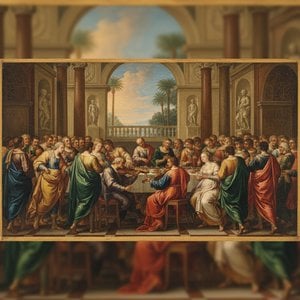
Beyond the delicate precision of his medals, Weber’s reputation extended to the grander scale of religious art. He was recognized for his ability to compose monumental church paintings that breathed life into sacred spaces. His style was characterized by a unique duality: the ability to evoke deep religious fervor through sweeping, dramatic compositions while maintaining a clarity and meticulousness that reflected the burgeoning Neoclassical movement. This balance made his work particularly resonant in an era where the intellectual rigor of the Enlightenment began to meet the enduring spiritual traditions of Italy.
Artistic Influence and Historical Resonance
The breadth of Weber's influence is further evidenced by the prestigious circles in which he moved. His mastery of detail and classical grace suggests a deep connection to the workshop of Antonio Canova, the titan of Neoclassical sculpture. By refining his skills within such an environment, Weber was able to embrace the ideals of purity and harmony championed by artists like Francesco Bartolomeo Rastrelli. This synthesis of styles—the dramatic Florentine Baroque and the poised Venetian Neoclassicism—allowed him to create works that were both emotionally stirring and intellectually sophisticated.
Though he passed away in 1806, leaving behind a legacy that spans both the intimate scale of bronze medals and the expansive scale of ecclesiastical frescoes, Giovanni Zanobio Weber remains a vital figure for understanding the transition of Italian art at the turn of the nineteenth century. His ability to translate the grandeur of history into the palm of a hand ensures that his artistry continues to captivate collectors and historians alike, serving as a testament to a life dedicated to the pursuit of beauty, faith, and form.
Q&A
Giovanni Zanobio Weber의 작품을 컬러 팔레트별로 둘러볼 수 있나요?
특정 색상 팔레트의 Giovanni Zanobio Weber 작품을 찾으시려면, 작가의 컬러 팔레트별로 보기 페이지를 이용해 보세요.
Giovanni Zanobio Weber 작가의 작품에서 가장 자주 나타나는 색상은 무엇인가요?
Giovanni Zanobio Weber 작가 작품의 컬러 프로필은 작가의 팔레트 지놈 페이지에서 확인하실 수 있습니다.
Giovanni Zanobio Weber의 작품 중 몇 점을 둘러보실 수 있나요?
전체 작품 보기 페이지에서 Giovanni Zanobio Weber의 작품 작품 1점점을 만나보실 수 있습니다.