The Artisan's Lineage and the Birth of Modernity
In the heart of Utrecht, where the scent of fresh sawdust and the rhythmic strike of a mallet once defined the daily rhythm, Gerrit Thomas Rietveld began his journey. Born in 1888 to a master joiner, his early years were steeped in the tactile language of wood and the disciplined precision of craftsmanship. This foundational intimacy with material was not merely a childhood memory but the very bedrock upon which he would later build a revolution. Before he ever sought to deconstruct form into abstract planes, Rietveld mastered the physical reality of the joint and the grain, honing his technical skills through night school and professional draughtsmanship. This marriage of manual dexterity and academic rigor allowed him to translate the most complex, abstract concepts into tangible, structural realities.The Geometry of Spirit: De Stijl and the Red/Blue Chair
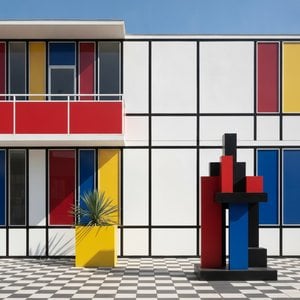
As the twentieth century unfolded, a radical new vision began to coalesce, one that sought to strip away the ornamental excesses of the past in favor of a pure, elemental truth. Rietveld emerged as a vital protagonist in the De Stijl movement, a group of visionaries who believed that art could be reduced to its most fundamental components: horizontal and vertical lines, and the primary triad of red, blue, and yellow. His 1917 creation, the Red/Blue Chair, stands as a profound manifesto in three dimensions. It is not merely furniture; it is a sculptural intersection of planes that defies the traditional weight of an object. By utilizing cantilevered elements and bold, primary colors, Rietveld transformed a functional household item into a dynamic exploration of space, where the boundaries between painting, sculpture, and architecture began to dissolve.Architectural Fluidity and a Lasting Legacy
Rietveld’s ambitions eventually transcended the confines of the workshop, spilling into the very structures that house human life. His architectural masterpiece, the Rietveld Schröder House, remains one of the most radical expressions of modern living ever conceived. In this Utrecht landmark, he abandoned the static, enclosed room in favor of a fluid, metamorphic environment. Through the ingenious use of sliding walls and open planes, he created a space that could breathe and change, mirroring the dynamism of the modern age. This vision of functionalism—where beauty is found in clarity, structure, and the honest expression of form—has left an indelible mark on the history of design. From his interactions with the Bauhaus to his enduring influence on geometric abstraction, Rietveld’s legacy continues to resonate, reminding us that true innovation lies in the courage to see the world through its most essential, unadorned lines.Q&A
Gerrit Rietveld 작가의 작품에서 가장 자주 나타나는 색상은 무엇인가요?
이 사이트에 등록된 작품 전반에 나타나는 Gerrit Rietveld의 색채 활용은 작가의 팔레트 지놈 페이지에서 자세히 살펴보실 수 있습니다.
Gerrit Rietveld 작가의 국적은 어디인가요?
Gerrit Rietveld은(는) Netherlands 출신입니다.
Gerrit Rietveld 작가의 작품 관련 통계 정보는 어디에서 확인할 수 있나요?
Gerrit Rietveld 작가의 작품 통계 정보는 방문 통계 페이지에서 확인하실 수 있습니다.