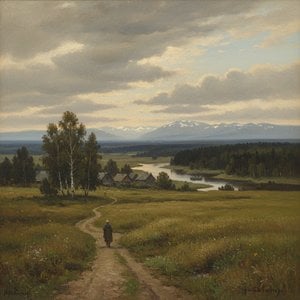
A Life of Quiet Determination
Fyodor Mikhailovich Slavyansky entered the world in 1817 within the village of Vyshkovo, located in the Tver Guberniya. His early years were defined by the heavy reality of his status as a serf belonging to the landlady Avdotya Nikolatelyna Semenova. Life for a young man in such circumstances was rarely shaped by personal choice, yet Slavyansky found a path toward a different existence through the brush and canvas.
In 1839, his life took a significant turn when he began working under Alexey Gavrilovich Venetsianov at the Safonkovo estate. This relationship was more than a simple apprenticeship; it was a lifeline. Venetsianov recognized the talent in his student and worked toward securing Slavyansky's freedom from servitude. By 1840, the path to formal training opened as Venetsianov petitioned the Academy to allow Slavyansky to attend drawing lessons. He spent those formative years absorbing the techniques of professors Varnek and Markov while continuing his practical work alongside his mentor.
The struggle for recognition and legal standing was a slow process, but by 1845, he had officially obtained the title of a freelance artist. This achievement marked the transition from a life of bonded labor to one of professional identity in the Russian art community.
Artistic Focus and Legacy
Slavyansky’s work was primarily centered on portraits. He possessed an eye for capturing the people around him, a skill evident in works such as his 1857 painting, On the Balcony, which depicts a self-portrait of the artist alongside his family. His paintings often reflected the quiet, domestic realities of the era.
Though he lived through a period of immense social change in Russia, Slavyansky remained rooted in the traditions he learned at the Academy and under Venetsianov. He passed away in Saint Petersburg on 18 February 1876. His life remains a notable example of how artistic dedication could bridge the gap between the life of a serf and that of a recognized painter.
Q&A
주제별로 분류된 Fyodor Slavyansky의 작품들은 어디에서 확인할 수 있나요?
Fyodor Slavyansky의 주제별 작품 모음는 작가의 작품들을 주제별로 찾아볼 수 있는 페이지입니다.
Fyodor Slavyansky의 작품을 사조별로 둘러볼 수 있나요?
모든 미술 사조 페이지에서는 Fyodor Slavyansky의 작품을 예술 사조별로 모아 볼 수 있습니다.
특정 색상 팔레트의 Fyodor Slavyansky 작품은 어디에서 찾아볼 수 있나요?
Fyodor Slavyansky의 작품은 작가의 컬러 팔레트별로 보기 페이지에서 컬러 팔레트별로 만나보실 수 있습니다.
Fyodor Slavyansky의 활동 시기는 어떻게 구분되어 있나요?
Fyodor Slavyansky의 예술적 여정은 연대기 페이지에서 시기별로 펼쳐집니다. 이곳에서는 작가의 활동 시기를 장(chapter)으로 나누어 작품들을 연대순 타임라인 형태로 한눈에 확인할 수 있습니다.