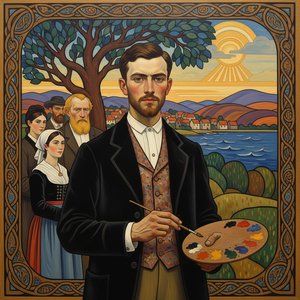
The Life and Background of Frederick Benjamin Barlin
The story of Frederick Benjamin Barlin begins within the close-knit community of the Chatham synagogue, where his father, Berliner, served as the chazzan. This lineage of religious service provided a distinct upbringing for the young man who would eventually find his calling not in the pulpit, but before the easel. Moving toward the bustling heart of London, Barlin sought to establish himself as a painter of men, focusing his talents on the art of portraiture.
His presence in the London art scene was marked by a period of intense activity during the early years of the nineteenth century. Between 1802 and 1807, he made his mark by exhibiting his work at the Royal Academy, a significant achievement for any artist of that era. These exhibitions allowed his hand to be recognized by the public and the establishment alike, cementing his place among the English portrait painters of his time.
Though his years of active practice were concentrated in a relatively brief window, his contributions to the visual record of his community were substantial. He moved through the social and religious circles of London with a purpose, capturing the likenesses of prominent figures with a steady hand. His life remains a quiet chapter in the history of English art, defined by his specific devotion to the faces of his contemporaries.
Notable Portraits and Engravings
The artist found his way to the Royal Academy, where his works were exhibited in 1802 and 1807. His hand was often called upon to capture the likenesses of significant religious figures, moving through the circles of London's prominent communities. He sought to record the faces of those who held spiritual authority, translating their presence onto canvas with a sense of dignity. One such subject was Solomon *Herschel, who served as the chief rabbi of the Ashkenazi Jews in England. Through his brush, the weight of leadership was given a visual form.
His brush also turned toward Raphael *Meldola, a Sephardi haham. In this portrait, Barlin chose to depict the subject wearing a three-cornered hat, a detail that lent the work a courtly and elegant character typical of the English style of that era. The likeness of Meldola proved so striking that it moved beyond the original painting; an engraving of the portrait was later published by Joshua Lopez, allowing the image to reach a wider audience than the canvas alone could manage.
The artist's influence extended into the realm of drawing and printmaking, where his sketches provided the foundation for others to follow. He produced an original drawing of Rabbi Solomon Hirschell, a man who would go on to be the Chief Rabbi of Great Britain. This particular work was so well received that W. Holl later created an engraving based upon Barlin's original drawing, ensuring the likeness of the rabbi remained in the public memory.
Q&A
키워드별로 분류된 Frederick Benjamin Barlin의 작품은 어디에서 볼 수 있나요?
특정 주제의 Frederick Benjamin Barlin 작품을 찾으려면 키워드별로 작품이 분류된 작가의 키워드별 탐색 페이지를 이용해 보세요.
Frederick Benjamin Barlin의 작품 전체 목록을 볼 수 있는 곳이 있나요?
이 사이트에 등록된 Frederick Benjamin Barlin의 모든 작품은 작가의 전체 작품 보기 페이지에서 만나보실 수 있습니다.
Frederick Benjamin Barlin 작가의 작품을 감상할 수 있는 가상 박물관에 방문할 수 있나요?
가상 방문이 가능합니다: Frederick Benjamin Barlin의 3D 갤러리 페이지에서 3D 갤러리를 통해 작가의 작품들을 만나보실 수 있습니다.
Frederick Benjamin Barlin가 그린 모든 주제를 한눈에 볼 수 있는 개요가 있나요?
주제별 작품 모음 페이지에서는 Frederick Benjamin Barlin의 작품들을 주제별로 확인하실 수 있습니다.