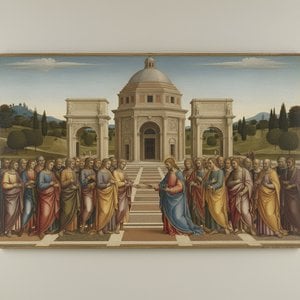
The Silesian Brush
Breslau, 1724. A painter named Anton Palko watches his son, Franz Xavier Karl Palko, begin his training within the walls of their home. This early instruction provides the foundation for a life spent moving through the artistic centers of Europe. The boy eventually leaves the domestic studio for the Academy of Fine Arts in Vienna, seeking a broader language of form and light. By the 1740s, the path leads to the Accademia di Belle Arti di Venezia, where the influence of Giuseppe Crespi begins to shape his hand.
His work is defined by a tension between the sacred and the secular. While he is often associated with religious scenes, his talent extends into the precision of portraiture and the fine lines of engravings. He moves through Bratislava, Kroměříž, and Brno, his reputation growing as he navigates the complex social structures of the era. In 1752, he reaches a professional peak when he is appointed a court painter for the Electorate of Saxony.
The Prague Conflict
The appointment in Saxony is short-lived. Palko moves to Prague, drawn by a commission from the Society of Jesus to paint frescoes at St. Nicholas Church. Here, the artist meets the friction of bureaucracy. The Painter's Guild protests his presence, arguing that because he is neither a guild member nor a citizen of Prague, he is an outsider. The dispute reaches a magistrate, who eventually rules in his favor, granting him permission to finish his work on the grounds that his status as a court painter carries equivalent weight to guild membership.
Despite this victory, Palko remains a man without a permanent citizenship in the city he calls home. He settles into a life of intense production, leaving behind frescoes and altarpieces that define the visual landscape of the region. His personal life remains anchored in the records of the time; in 1756, baptismal records note the birth of his son, Jan Xaver, to his wife, Marie Anna Bursch of Saxony.
Final Movements
The end of his life is shrouded in uncertainty. One version of history places his death in Prague in 1767. Another suggests a more desperate final chapter: a move to Munich, driven by the hope of securing a position as a court painter for the Electorate of Bavaria. That ambition fails. If the second account holds true, he died in Munich, living in poverty.
His legacy is carried forward by his brother, Franz Anton Palko, who also achieved recognition as a painter. The works of Franz Xavier Karl Palko remain tied to the specific religious and historical requirements of the mid-18th century, captured in:
- Religious frescoes and altarpieces.
- Portraiture of the era.
- Detailed engravings.
Q&A
Franz Xavier Karl Palko은(는) 어느 시대의 작품을 남겼나요?
Franz Xavier Karl Palko은(는) Early Modern 시대에 활동했습니다. 이 시기는 역사적 맥락 속에서 작가의 예술적 위치를 보여줍니다.
Franz Xavier Karl Palko 작가의 국적은 어디인가요?
Franz Xavier Karl Palko은(는) Poland 출신입니다.
Franz Xavier Karl Palko 작품의 연도별 타임라인이 있나요?
Franz Xavier Karl Palko의 작품 연표를 확인해 보세요: 작품 연대기 페이지에서 작품들을 제작 날짜순으로 보실 수 있습니다.