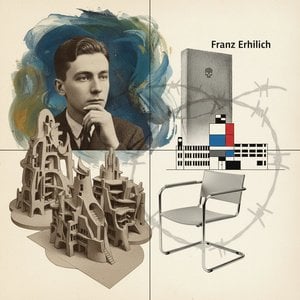
Early Life, Family and Training
Munich, 25 May 1870. Franz Naager enters a world of legal order as the son of a Munich public prosecutor. His upbringing is rooted in the structured environment of the city's judicial class, yet his path diverges early toward the tactile and the visual. By the age of sixteen, the formal discipline of the Munich Kunstgerwerbeschule begins. Under the guidance of Ferdinand Barth, the young student begins to master the technical foundations of craft and design.
The momentum builds. On 24 May 1889, Naager enters the Munich Academy of Art. His training becomes a multifaceted immersion under several hands: Alexander Strähuber, Ferdinand Barth, and Gabriel von Hackl. The curriculum is rigorous, pushing him toward a mastery of form that spans multiple disciplines. By 1890, the focus shifts as he moves to the Munich Academy to work with the painter and craftsman Rudolf Seitz. This period of intense study refines his ability to navigate the intersection of fine art and applied craft, setting the stage for a career that would eventually demand expertise in everything from engraving to sculpture.
Life and Activity in Venice
Venice becomes the center of Naager's world from 1901 to 1913. He does not merely visit; he embeds himself in the city's fabric, working as an artist while simultaneously acting as a collector. He acquires works by masters such as Bellini, Giorgione, Greco, Magnasco, Tintoretto, Titian, and Veronese. This period marks a shift from student to entrepreneur and connoisseur.
The scale of his operation grows rapidly. He establishes art workshops that employ approximately 200 people. These facilities are not limited to single disciplines; they function as hubs for sculpture, architecture, and interior decoration. His presence in the city is cemented by his marriage to a Venetian woman, Nice Della Rovere.
Patrons, Workshop and Commissions
Naager’s influence extends far beyond the canvas, manifesting in the very architecture of major urban centers. In 1910, his hand shaped the facade of the Berlin Admiralspalast through the design of relief panels carved from Istrian limestone. This period of high-profile architectural contribution continued in Munich around 1911, when he created terracotta friezes for the A. S. Drey building on Max-Joseph-Straße. His ability to bridge the gap between fine art and decorative craftsmanship made him a sought-after figure for large-scale urban projects.
His professional standing reached a peak of formal recognition through state honors and institutional affiliations. In 1913, the Prussian State awarded him the title of Professor. This institutional respect was mirrored in his home city, where he was elected an honorary member of the Munich Art Academy in 1922. Beyond these formal accolades, he maintained active ties to the local creative community as a member of the Munich artists' association "Allotria".
Techniques and Artistic Works
Naager operates across a vast technical spectrum, moving from the delicate precision of printmaking to the heavy permanence of stone. His hand moves through engraving, etching, and aquatint, often utilizing mezzotint to achieve specific tonal depths. In the realm of graphic arts, he explores fantasy and landscape through these varied methods. His reach extends into the physical architecture of spaces through the creation of mosaics and marble inlays. He even applied his technical curiosity to domestic design, inventing a new process for printing wallpaper.
The scale of his work shifts from the intimate to the monumental. He crafts sculptural jewelry and works in terracotta, a medium he utilized for the friezes on the facades of the A. S. Drey building in Munich, which were produced at the Nymphenburg Porcelain Manufactory. His relief work and sculptural contributions define the surfaces of significant structures, such as the Istrian limestone relief panels designed for the main facade of the Berlin Admiralspalast in 1910. Whether working in the fine lines of a print or the mass of a relief, his output remains defined by this technical versatility.
Q&A
Franz Naager의 작품을 기법별로 모아볼 수 있는 곳은 어디인가요?
모든 매체별 페이지에서는 Franz Naager의 작품을 기법별로 모아볼 수 있습니다.
Franz Naager의 작품은 얼마나 인기가 있나요?
이 사이트에서 Franz Naager의 작품에 관한 통계를 확인할 수 있는 방문 통계 페이지를 만나보세요.
Franz Naager 작가의 작품을 연도별로 어떻게 확인할 수 있나요?
Franz Naager의 작품을 연도별로 정리하여 보여주는 작품 연대기 페이지입니다.
Franz Naager 작가는 어떤 사조의 작품 활동을 했나요?
Franz Naager의 작품은 작가의 모든 미술 사조 페이지에서 사조별로 만나보실 수 있습니다.