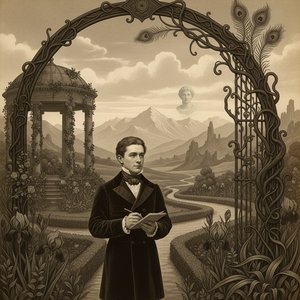
Frank Stone (1800–1859): A Victorian Painter Against the Grain
Frank Stone (1800–1859) stands as a singular figure in Victorian art—a self-taught Englishman who defied convention and championed an aesthetic antithetical to the prevailing trends of his time. Born in Manchester, he eschewed formal artistic training, embarking instead on a path of independent exploration that yielded remarkable results: portraits imbued with psychological depth, Shakespearean scenes rendered with meticulous detail, and sentimental subjects executed with a masterful sensitivity for color and texture.
- Early Life & Education
- Career Highlights: Portraits & Shakespeare
- The Pre-Raphaelite Controversy
- Associations with Dickens & Thackeray
- Legacy & Influence
Early Life & Education
Frank Stone’s artistic journey began without the benefit of academic instruction. He was born in Manchester, England, on August 22nd, 1800—the son of a textile merchant—and received his education primarily at home and at Bolton Grammar School. Despite lacking formal training, Stone possessed an innate talent for observation and representation, qualities that would prove crucial to his subsequent success as a painter.
- Family Background
- Education at Bolton Grammar
Career Highlights: Portraits & Shakespeare
Stone’s artistic reputation solidified through his prolific output of portraits—works characterized by their psychological realism and expressive handling of light and shadow. He quickly gained recognition as an artist, attracting commissions from wealthy patrons across England. Notably, he collaborated extensively with William Makepeace Thackeray on theatrical productions, contributing costumes and designs that reflected the Victorian fascination for historical accuracy.
- Portrait Painting Technique
- Collaboration with Thackeray
The Pre-Raphaelite Controversy
Stone’s artistic convictions placed him squarely at odds with the burgeoning Pre-Raphaelite Brotherhood—a movement that championed a return to medieval art and rejected academic conventions. He vehemently opposed their stylistic innovations, arguing for a more truthful depiction of nature and human emotion. This stance fueled a heated debate within the Royal Academy, where Stone served as an Associate Member, marking him as one of the foremost voices against Pre-Raphaelite dogma.
- Stone’s Critique of Pre-Raphaelitism
- Royal Academy Involvement
Associations with Dickens & Thackeray
Frank Stone enjoyed a particularly close relationship with Charles Dickens—a friendship forged during their shared participation in amateur theatricals. Dickens recognized Stone's talent for costume design and his astute understanding of Victorian sensibilities, fostering a bond that endured throughout their lives. Their collaboration extended beyond the stage, encompassing literary endeavors and social engagements, cementing Stone’s place as one of Dickens’s most trusted companions.
- Dickens & Stone's Friendship
- Collaborative Theatre Productions
Legacy & Influence
Frank Stone’s artistic legacy extends beyond his individual paintings—he profoundly shaped the aesthetic landscape of Victorian England. His unwavering commitment to truthfulness and emotional resonance served as a counterpoint to the prevailing stylistic trends, inspiring subsequent generations of artists to pursue originality and authenticity. Today, Stone's work continues to captivate viewers with its evocative beauty and psychological insight—a testament to his enduring contribution to art history.
- Impact on Victorian Art
- Enduring Artistic Reputation
Q&A
Frank Stone의 작품을 연도순으로 어디에서 볼 수 있나요?
Frank Stone의 작품 연표를 확인해 보세요: 작품 연대기 페이지에서 작품들을 제작 날짜순으로 보실 수 있습니다.
Frank Stone은(는) 어느 시대의 작품을 남겼나요?
Frank Stone은(는) 19th Century 시대에 활동했습니다. 이 시기는 역사적 맥락 속에서 작가의 예술적 위치를 보여줍니다.
Frank Stone의 연도별 활동 기록이 있나요?
Frank Stone의 작품 세계를 시간순으로 정리한 기록은 아티스트 연대기 페이지에서 확인하실 수 있으며, 이곳에서는 각 시기별로 분류된 챕터를 따라 작품들을 제작 순서대로 만나보실 수 있습니다.