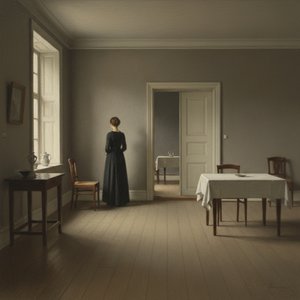
The Sculptural Eye of Flemming Bergsøe
Born in Frederiksberg, Denmark, Flemming Bergsøe began his artistic path through the study of form and volume. While his early training at the Academy led him toward the sculpture school under Professor Einar Utzon-Frank, his true vocation eventually settled upon the canvas and the print. This foundation in three-dimensional thinking remained a constant throughout his life, dictating how he perceived the weight and presence of the objects he chose to depict. He was a man of many disciplines, moving between the roles of painter, graphic artist, and author, often seeking a quietude that reflected in his muted palette.
His early years were marked by a restless movement through Europe. After leaving the Academy in 1928, he traveled through France and Italy, absorbing the light and structure of the continent. This period of wandering helped shape a style rooted in figurative representation, where the essence of a subject was found in its physical reality rather than in decorative flourish. He was deeply influenced by the Impressionists and the structural clarity of Cézanne, seeking to capture the world through a lens of controlled observation.
Evolution of Motif and Form
The progression of Bergsøe’s work reveals a shifting focus that mirrored his changing surroundings and interests. His output can be understood through several distinct phases of observation:
- The Suburban Years: During the 1930s, his gaze turned toward the allotment gardens and suburban landscapes of Copenhagen, particularly the areas around his birthplace of Frederiksberg.
- The Circus and the Countryside: In the 1950s, his work embraced the dramatic volumes of the circus, including time spent with Circus Benneweis, alongside a renewed interest in the rural architecture of Southern Zealand, such as mills and churches.
- The Minimalist Turn: By the 1960s, his compositions had stripped away complexity, focusing instead on the pure geometry of spheres, cones, and eggs.
This evolution was not a departure from his training but a refinement of it. Whether he was painting a circus tent or a simple piece of crumpled paper, he approached the subject as a sculptor might, looking for the underlying structure that gives an object its place in space. His work in the 1940s saw a temporary pause in painting as he turned his intellect toward literature, editing the journal Aarstiderne and publishing fiction, a period of intellectual expansion that informed his visual precision.
A Life of Quiet Precision
Bergsøe was a significant figure in the Danish art community, contributing to the establishment of the Corner exhibition. His work was characterized by a preference for the understated, finding meaning in the everyday scenes of life rather than the spectacular. He possessed a rare ability to treat a building or a simple household object with the same gravity, ensuring that the physical presence of his subjects was never lost to mere likeness. His legacy is found in this commitment to the tangible, a pursuit that continued until his death in Kongens Lyngby.
Q&A
특정 주제별로 Flemming Bergsøe의 작품을 어떻게 찾아볼 수 있나요?
특정 주제의 Flemming Bergsøe 작품을 찾으려면 키워드별로 작품이 분류된 작가의 키워드별 탐색 페이지를 이용해 보세요.
Flemming Bergsøe의 작품들은 어떤 분위기를 담고 있나요?
아티스트의 무드 룸 페이지에서는 Flemming Bergsøe의 작품들을 분위기에 따라 큐레이션된 형태로 만나보실 수 있습니다.
Flemming Bergsøe의 활동 시기는 어떻게 구분되어 있나요?
Flemming Bergsøe의 작품 세계를 시간순으로 정리한 기록은 아티스트 연대기 페이지에서 확인하실 수 있으며, 이곳에서는 각 시기별로 분류된 챕터를 따라 작품들을 제작 순서대로 만나보실 수 있습니다.
Flemming Bergsøe의 작품은 얼마나 인기가 있나요?
Flemming Bergsøe의 방문 통계 페이지에서는 이 사이트에 등록된 작가의 작품들을 바탕으로 산출된 통계 정보를 제공합니다.