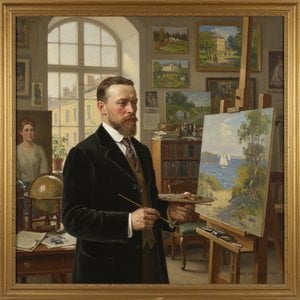
The Life and Academic Career of Ferdinand Pauwels
Ferdinand Pauwels was a Belgian history painter who lived and worked in Germany. His formal training began between 1842 and 1850 at the Royal Academy of Fine Arts in Antwerp, where he studied under Gustave Wappers and Nicaise De Keyser, developing his skills as an outstanding colorist. In 1852, he was awarded the Prix de Rome for Belgium for his painting Coriolanus at Rome, which allowed him to spend four years studying in Italy.
His career included significant academic roles, serving as the Professor of History Painting at the Weimar Saxon-Grand Ducal Art School from 1862 to 1872. During this productive period, he completed seven large wall panels at the Wartburg depicting the life of Martin Luther. Later, he became a professor at the Dresden Academy of Fine Arts, where he taught students such as Ludwig von Hofmann, Osmar Schindler, Paul Thumann, and Oskar Zwintscher.
Major Works and Historical Commissions
Pauwels is noted for several large-scale historical commissions. In addition to his work at the Wartburg, he executed six large historical wall panels at the Fürstenschule in Meissen. Between 1870 and 1881, he produced what was considered his greatest work: twelve frescoes in the upper part of the Ypres Cloth Hall. These frescoes, which depicted scenes from the history of Ypres from 1187 to 1383, were left incomplete by Charles de Groux. While most of the Cloth Hall and these frescoes were destroyed during World War I, the city of Ypres eventually acquired six of his paintings for its Municipal Art Museum.
Q&A
Ferdinand Pauwels 작가의 작품에서 가장 자주 나타나는 색상은 무엇인가요?
Ferdinand Pauwels 작가 작품의 컬러 프로필은 작가의 팔레트 지놈 페이지에서 확인하실 수 있습니다.
주제별로 Ferdinand Pauwels의 작품을 찾아볼 수 있나요?
Ferdinand Pauwels의 주제별 작품 모음는 작가의 작품들을 주제별로 찾아볼 수 있는 페이지입니다.
Ferdinand Pauwels 작가의 국적은 어디인가요?
Ferdinand Pauwels은(는) Belgium 출신입니다.