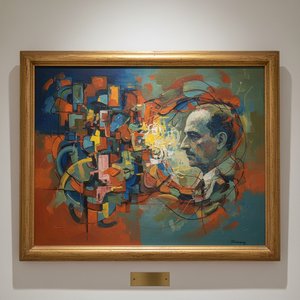
A Visionary of Form and Color: The World of Federico José Herrero Vargas
Born in the vibrant heart of San José, Costa Rica, in 1978, Federico José Herrero Vargas has emerged as a profound voice in contemporary abstract art. His journey is one deeply rooted in a rich familial legacy; raised by parents who were artists themselves, Herrero was immersed in a world where creativity was the primary language of expression. This early exposure nurtured an innate sensitivity to light, texture, and form, allowing him to develop a visual vocabulary that transcends simple representation. His work does not merely depict the world but seeks to distill its very essence into a rhythmic dance of geometry and hue.
The evolution of Herrero’s technique is a testament to his dedication to the craft of painting. Through years of rigorous study and experimentation, he moved beyond traditional boundaries to embrace a style defined by geometric precision and an audacious use of color. His canvases serve as a bridge between the structured logic of Minimalism and the organic vitality found in the Costa Rican landscape. By utilizing simplified shapes—circles, squares, and triangles—he constructs complex compositions that evoke the dynamism of urban life while maintaining the serene, meditative quality of nature. Each stroke is intentional, contributing to a larger tapestry where color functions as an emotional conduit, capable of conveying depth and movement without the need for literal imagery.
Global Recognition and Artistic Milestones
Herrero’s ascent in the international art scene was marked by extraordinary early success, most notably his recognition at one of the world's most prestigious cultural stages. In 2001, he was awarded the special prize for young artists at the 49th Venice Biennale, a milestone that signaled his arrival as a significant figure in contemporary global art. This achievement brought his unique perspective to the forefront of international discourse, highlighting how a Central American sensibility could resonate within the broader movements of abstraction and constructivism.
Beyond his individual accolades, Herrero has demonstrated a profound commitment to the cultivation of the artistic community. As the founder of Despacio, an international contemporary art center in San José, he has played a pivotal role in fostering dialogue and providing a platform for emerging voices in Costa Rica. His work continues to be celebrated for its ability to harmonize the tension between chaos and order, making his paintings not just objects of beauty, but profound explorations of how we perceive the structure of our reality.
The enduring significance of his oeuvre lies in its universal appeal:
- Chromatic Intensity: A mastery of palette that captures both the tropical warmth of his homeland and a modern, urban energy.
- Geometric Harmony: The use of mathematical precision to create compositions that feel both structured and organic.
- Cultural Synthesis: An ability to blend the influences of international movements like Constructivism with the unique light and spirit of Latin American landscapes.
Q&A
Federico Herrero의 작품을 색상별로 정렬해서 볼 수 있나요?
Federico Herrero의 작품은 작가의 컬러 인덱스 페이지에서 색상별로 감상하실 수 있습니다.
Federico Herrero 작가의 작품을 감상할 수 있는 가상 박물관에 방문할 수 있나요?
가상 방문이 가능합니다: Federico Herrero의 3D 갤러리 페이지에서 3D 갤러리를 통해 작가의 작품들을 만나보실 수 있습니다.
Federico Herrero의 연도별 활동 기록이 있나요?
Federico Herrero의 예술적 여정은 연대기 페이지에서 시기별로 펼쳐집니다. 이곳에서는 작가의 활동 시기를 장(chapter)으로 나누어 작품들을 연대순 타임라인 형태로 한눈에 확인할 수 있습니다.
주제별로 Federico Herrero의 작품을 찾아볼 수 있나요?
Federico Herrero의 주제별 작품 모음는 작가의 작품들을 주제별로 찾아볼 수 있는 페이지입니다.