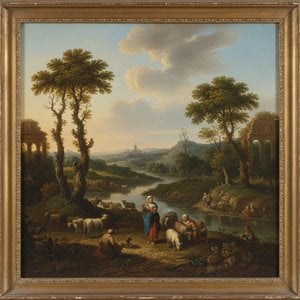
From Humble Apprenticeship to Artistic Refinement
Evert Pieters’ journey began not in the gilded halls of an academy, but within the practical, tactile world of a house painter’s apprenticeship. Born in Amsterdam in 1856 to a family of modest means, his early exposure to the raw elements of pigment and surface would later lend a profound, grounded quality to his brushwork. This foundational discipline paved the way for a more formal pursuit of beauty, leading him to the Academy of Amsterdam and eventually toward the vibrant artistic landscape of Antwerp. In the late 1870s, Pieters sought the mentorship of masters like Charles Verlat and Theodoor Verstraete, finding in their guidance a bridge between his technical training and the burgeoning movements of European art.The Golden Light of Flanders and the Barbizon Spirit
As his talent blossomed, Pieters’ work began to capture the soul of the landscape, deeply influenced by the traditions of the Old Dutch Masters and the atmospheric sensibilities of the Barbizon School. His time in Belgium was marked by significant triumphs, most notably his recognition at the Second International Exhibition in Antwerp, where his evocative depiction of a Flemish wheatfield earned him a prestigious medal. This period of his life was characterized by a deep connection to the earth and sky, as he moved between Paris and the tranquil environs of Barbizon, honing a style that balanced classical structure with an emerging softness.- The mastery of light: His ability to render the subtle shifts of sunlight across rural scenery.
- A connection to tradition: Drawing inspiration from the textures and compositions of 17th-century Dutch landscapes.
- Narrative interiors: The introduction of human elements into domestic settings, creating a sense of quiet intimacy.
An Impressionistic Legacy in Coast and Color
In his later years, Pieters’ palette underwent a luminous transformation. Moving to Katwijk aan Zee, he turned his gaze toward the rhythmic beauty of the coast, where his brushstrokes became more fluid and impressionistic. The tranquil beach scenes, featuring sailboats and riders against muted blues and sandy tones, showcased a master at peace with the changing tides of art history. Even as his work embraced the loose, energetic textures of Impressionism—often focusing on the delicate beauty of floral still-lifes—the core of his artistry remained rooted in that initial, profound observation of nature. His life, which came to an abrupt end in Laren, left behind a legacy of light, texture, and a timeless devotion to the Dutch landscape.질의응답
주제별로 분류된 Evert Pieters의 작품들은 어디에서 확인할 수 있나요?
Evert Pieters의 작품은 작가의 주제별 아틀라스 페이지에서 주제별로 찾아보실 수 있습니다.
Evert Pieters의 작품을 컬러 팔레트별로 둘러볼 수 있나요?
특정 색상 팔레트의 Evert Pieters 작품을 찾으시려면, 작가의 컬러 팔레트별 페이지를 이용해 보세요.
Evert Pieters은(는) 어느 시대에 활동했나요?
Evert Pieters은(는) 19th Century 시대에 활동했습니다. 이 시기는 역사적 맥락에서 작가의 활동 위치를 보여줍니다.