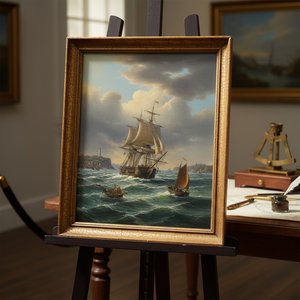
The Life and Artistic Evolution of Everett Warner
Born in Vinton, United States, Everett Warner was an American Impressionist painter and printmaker. His early education included studies at the Corcoran Museum and the Washington Art Students League, followed by training at the Art Students League in New York under George Bridgman and Walter Clark. Warner's work gained recognition through selection for prestigious competitions at the Art Institute of Chicago, the Pennsylvania Academy of the Fine Arts, and the National Academy of Design. He also served as an art critic for the Evening Star in Washington, D.C.
Warner's career was marked by significant contributions to maritime history. During World War I, he developed the Warner System, a ship camouflage method designed to break up a vessel's silhouette to make it difficult for enemies to obtain a range. He served as a lieutenant in the US Naval Reserves, managing a design-based subdivision in Washington, D.C. He later returned to serve as Chief Civilian Aid to Commander Charles Bittinger during World War II to assist in the design of ship camouflage.
Artistic Experiments and Later Years
Beyond his maritime work, Warner explored unique perspectives through aerial painting. Following the end of World War I, he utilized military seaplanes to observe New York City and the Eastern seaboard from above, becoming one of the first artists to sketch and paint from an aerial view. He even experimented with anamorphosis, displaying his large-scale paintings flat on the floor to be viewed from an oblique angle to enhance the sense of depth.
In his later professional life, Warner held a position as an associate professor of painting and design at the Carnegie Institute of Technology in Pittsburgh, Pennsylvania, for eighteen years. After retiring from teaching, he settled in Westmoreland, New Hampshire. He eventually transitioned from painting to writing articles for publication before his death in 1963.
Q&A
Everett Warner의 작품을 분위기별로 모아둔 곳은 어디인가요?
아티스트의 무드 룸 페이지에서는 Everett Warner의 작품들을 분위기에 따라 큐레이션된 형태로 만나보실 수 있습니다.
Everett Warner 작가 작품의 컬러 프로필은 어디에서 확인할 수 있나요?
이 사이트에 등록된 작품 전반에 나타나는 Everett Warner의 색채 활용은 작가의 팔레트 지놈 페이지에서 자세히 살펴보실 수 있습니다.
Everett Warner의 연도별 활동 기록이 있나요?
Everett Warner의 연대기는 작가의 활동 시기별로 분류된 작품들을 연대순으로 보여주는 스크롤 방식의 타임라인입니다.
Everett Warner의 출생 도시와 국가는 어디인가요?
Everett Warner은(는) United States Vinton에서 태어났습니다.