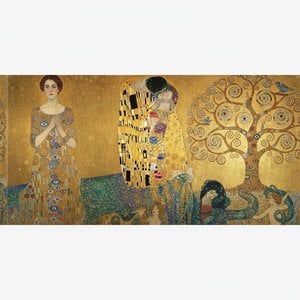
The Weaver of Viennese Modernity
Emilie Louise Flöge was far more than a mere silhouette in the periphery of Gustav Klimt’s golden canvases; she was a visionary architect of style who draped the Vienna Secession in its most radical and liberating forms. Born in 1874 to a master turner of meerschaum pipes, Flöge inherited a profound respect for craftsmanship and the intricate beauty of fine detail. Her journey from a young seamstress to a celebrated couturière was marked by an unwavering commitment to the Reform Style, a movement that sought to unshackle the female form from the suffocating constraints of the corset. Through her hands, fashion became a medium of political and social expression, mirroring the avant-garde spirit of a city on the precipice of modernity.
Her life was inextricably woven with that of Gustav Klimt, a bond that transcended simple romance to become one of the most significant intellectual and aesthetic partnerships in art history. While their connection was famously characterized by an emotional intimacy rather than physical union, Flöge served as both his muse and a vital collaborator. The very textures that define Klimt’s "Golden Phase"—the swirling patterns, the geometric abstractions, and the shimmering mosaics—found a tangible, wearable reality in Flöge’s designs. She did not merely dress the elite; she clothed the ideals of an era, translating the complex symbolism of the Jugendstil movement into flowing silks and patterned robes that moved with the grace of living art.
A Legacy of Fabric and Freedom
The establishment of her salon, Schwestern Flöge, on the bustling Mariahilfer Strasse, marked a pinnacle in her career as a businesswoman and designer. In partnership with her sister Helene, she created a sanctuary of taste where the architecture of Josef Hoffmann met the revolutionary silhouettes of the Wiener Werkstätte. Her garments were masterpieces of liberation, featuring high bodices, billowing sleeves, and loose, artistic patterns that championed women's health and autonomy. To wear a Flöge creation was to participate in a feminist dialogue, asserting a new identity for the modern woman who demanded both elegance and ease of movement.
Despite the encroaching shadows of the 20th century—including the devastating impact of the Anschluss which forced the closure of her salon—Flöge’s influence remained undimmed. Her historical significance lies in her ability to bridge the gap between fine art and functional design, proving that the aesthetic revolutions occurring on canvas could be lived and breathed through the very clothes on one's back. She remains a symbol of the Viennese Bohemian spirit: an artist of the needle who helped stitch together the fragmented pieces of a changing world, leaving behind a legacy of beauty that continues to inspire the intersection of fashion and fine art.
질의응답
Emilie Louise Flöge의 경력은 어떻게 시기별로 구분되어 있나요?
Emilie Louise Flöge의 연대기는 작가의 활동 시기별로 분류된 작품들을 연대순으로 보여주는 스크롤 방식의 타임라인입니다.
Emilie Louise Flöge의 작품 전체 목록을 볼 수 있는 곳이 있나요?
본 웹사이트에 등록된 Emilie Louise Flöge의 모든 작품은 작가의 모든 작품 보기 페이지에서 확인하실 수 있습니다.
Emilie Louise Flöge의 작품을 색상 스펙트럼별로 살펴볼 수 있나요?
Emilie Louise Flöge의 작품은 작가의 색상별 인덱스 페이지에서 색상별로 살펴보실 수 있습니다.