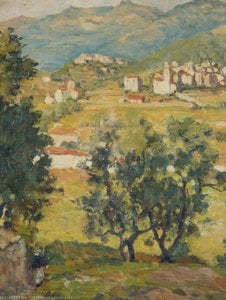
The Architect of the Arts and Crafts Movement
Born into the industrial heart of Middleton on May 17, 1860, Edgar Wood emerged as a defining figure of the British Arts and Crafts movement. His life was shaped by the tension between tradition and individual ambition; while his father, a strict mill owner, envisioned a future for Edgar within the family cotton business, the young man possessed an irrepressible artistic spirit. This early conflict eventually yielded to a compromise that would define his legacy: he would train as an architect, allowing him to marry structural precision with the soulful, decorative aesthetics of a true artist. Educated at the local Queen Elizabeth Grammar School, Wood’s path was paved through his articles at Mills and Murgatroyd, a prestigious Manchester firm where he honed the technical mastery that would later allow him to breathe life into stone and timber.
Wood's creative philosophy was deeply rooted in the vernacular traditions of Lancashire. Unlike architects who sought to impose grand, foreign styles upon the landscape, Wood found beauty in the local, the domestic, and the tactile. His work is characterized by a profound respect for materials and a desire to integrate architecture with the natural environment. As a proponent of the Arts and Crafts movement, he championed the idea that every element of a building—from its structural bones to its smallest ornamental detail—should be crafted with care and integrity. This devotion to craftsmanship saw him focusing primarily on smaller-scale projects, such as domestic residences and churches, which allowed him to maintain personal control over the design process and ensure that his artistic vision remained uncompromised.
A Legacy Carved in Lancashire
The breadth of Wood's influence extended far beyond the borders of a single city, though Manchester remained his spiritual and professional anchor. His architectural footprint can be found scattered across the towns of Rochdale, Oldham, and Middleton, as well as in more outlying districts like Bramhall and Hale. Through his work, he transformed the local landscape, creating buildings that felt both timeless and deeply connected to their surroundings. His contributions were not merely structural but also communal; as a founder of the Northern Art Workers' Guild in 1896, he helped foster a vibrant ecosystem for provincial artists, ensuring that the spirit of craftsmanship would endure in the North of England.
Wood’s professional achievements were marked by leadership and recognition within his field. His tenure as President of the Manchester Society of Architects from 1911 to 1912 stands as a testament to the respect he commanded among his peers. Even as the architectural landscape shifted toward more modern, industrial styles in the early 20th century, Wood remained steadfast in his commitment to the principles of beauty and utility. Today, his legacy is preserved through the many listed buildings that stand as monuments to his skill. To study the work of Edgar Wood is to witness a masterclass in how architecture can serve as an extension of the human soul, blending the ruggedness of industrial Lancashire with the delicate elegance of fine art.
질의응답
Edgar Wood의 작품은 얼마나 인기가 있나요?
Edgar Wood의 통계 페이지에서는 본 웹사이트에 등록된 작가의 작품들을 바탕으로 산출된 통계 정보를 제공합니다.
주제별로 Edgar Wood의 작품을 탐색할 수 있나요?
Edgar Wood의 주제별 아틀라스는 작가의 작품들을 주제별로 분류하여 보여주는 페이지입니다.
Edgar Wood의 작품 중 몇 점을 둘러보실 수 있나요?
모든 작품 보기 페이지에서 Edgar Wood의 작품 작품 9점점을 만나보실 수 있습니다.