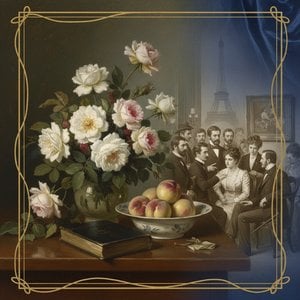
The Soul of the Streets: The Life and Art of Edgar Chahine
Born in the imperial grandeur of Vienna in 1874, Edgar Chahine’s life was a tapestry woven from the diverse threads of the late nineteenth-century world. Though his beginnings were Austrian, his spirit was shaped by the vibrant, multicultural atmosphere of Constantinople, where he spent his formative years. As the son of a prominent director of the Ottoman Bank, Chahine possessed the rare privilege of pursuing his artistic passions without the shadow of financial hardship. This early stability allowed him to follow the whispers of his talent across Europe, moving first to the sun-drenched academies of Venice and eventually to the beating heart of the art world: Paris. His journey was not merely a geographical migration but an emotional evolution, as he transitioned from a student of classical traditions to a master of capturing the raw, unvarnished truth of human existence.
Chahine’s education was as prestigious as it was varied. In Venice, under the guidance of Antonio Ermolao Paoletti at the Academia di Belle Arti, he honed his technical precision, absorbing the classical elegance of the Italian masters. However, it was in Paris, after enrolling at the Académie Julian in 1895, that his true voice emerged. He became a chronicler of the Belle Époque, yet unlike many of his contemporaries who sought only to depict the glittering surface of Parisian high society, Chah ine possessed an empathetic eye for the marginalized. His debut at the Paris Salon in 1896, featuring a poignant portrait of a beggar, set the stage for a career defined by social observation and profound humanism.
Mastery of Line and Light
The true brilliance of Chahine lay in his extraordinary command over printmaking, particularly etching and drypoint. He possessed an uncanny ability to translate the fleeting textures of life—the rough fabric of a laborer's coat, the misty atmosphere of a Parisian street, or the delicate grace of a socialite—into the stark language of black ink on paper. His technical innovation was most evident in his development of a sophisticated two-plate system for color printmaking, a collaboration with the skilled Eugene Delabre that allowed him to infuse his works with a subtle, atmospheric warmth. This mastery earned him international acclaim, including gold medals at both the Universal Exhibition in Paris in 1900 and the Venice Biennale in 1903.
His thematic repertoire was as vast as the cityscapes he inhabited. Chahine’s work often oscillated between two poles of Parisian life:
- The Elegance of Society: Capturing the refined movements and sophisticated fashion of the upper classes, documenting the grace of a bygone era.
- The "Lamentable Life": A deeply moving series of works that turned his gaze toward the impoverished, the street vendors, circus performers, and the weary souls navigating the fringes of urban existence.
A Legacy Etched in History
Despite his immense success, Chahine’s life was marked by the tragic loss of much of his physical oeuvre. The fires and floods of the early twentieth century claimed a significant portion of his prints, leaving behind only fragments of a once-vast collection. Yet, the impact of his work remained indelible. As a founding member of Ani, the Union of French-Armenian Artists of Paris, he maintained a profound connection to his Armenian heritage, often weaving subtle cultural themes into his European observations. His recognition by the French state through the Légion d'Honneur in 1932 stands as a testament to his integration into the very fabric of French artistic identity.
Today, Chahine is remembered not just as an illustrator or an engraver, but as a visual poet of the human condition. His ability to find dignity in poverty and beauty in the mundane ensures that his legacy continues to resonate. Through the delicate scratches of his drypoint needle, he captured the fleeting heartbeat of Paris, preserving for eternity the faces and the shadows of a world that has long since passed into history.