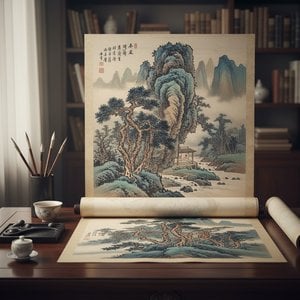
A Legacy in Ink and Paper
The life of Dong Qi unfolded during the Qing dynasty, a period when the brush and the inkstone were central to the expression of the scholar-artist. Born in 1772, he lived through a transformative era in China, contributing to a family tradition that saw art as a shared language across generations. His work was often part of a larger conversation, a collaborative effort where the boundaries between individual expression and family heritage became beautifully blurred.
His hand moved across paper and silk, capturing the quiet details of the natural world. He did not merely paint objects; he sought to record the essence of life as it appeared in the subtle shifts of light and shadow. His compositions often focused on the delicate structures of the environment, finding depth in the simplest of subjects.
The Language of Nature
Dong Qi’s technical approach was rooted in a deep observation of the physical world. He was known for his ability to translate the textures of the earth and the lightness of the air into ink and color. His repertoire was diverse, covering a wide range of natural subjects that required both precision and a sense of rhythm.
His artistic output included:
- Detailed depictions of flowers and fruit
- The structural elegance of bamboo and plum branches
- The rugged presence of stones and landscapes
- The intricate patterns of plumage
In many of his works, he utilized a specific method of sketching, sometimes noting his adherence to certain traditional styles of observation. This commitment to accuracy allowed him to create works that felt grounded in reality, even when they were part of a highly stylized tradition. His inscriptions, written in both regular and running scripts, added a layer of literary depth to his visual compositions.
A Family Tradition
Much of what remains of Dong Qi’s contribution to art history is tied to the collective memory of his family. He was a key participant in collaborative albums, where multiple members of the Dong family would contribute leaves to a single collection. These albums, such as the one held in the Palace Museum in Beijing, serve as a record of a family’s shared aesthetic and intellectual life. These works often spanned decades, with some leaves dated to 1817 and others much later, showing how his influence and the family's artistic practice endured through time.
By working within these collaborative frameworks, Dong Qi helped maintain a continuity of style and spirit. His presence in these albums ensures that his individual hand is woven into the broader history of Chinese painting, preserved through the careful hands of collectors and historians.