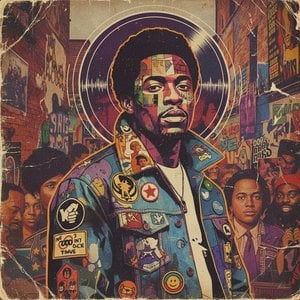
Derek Boshier: A British Pop Icon Challenging the Status Quo
Born in Portsmouth, England, in 1937, Derek Boshier’s artistic journey was one of constant evolution and a relentless interrogation of contemporary culture. Initially drawn to painting after studying at Yeovil School of Art and later the Royal College of Art alongside luminaries like David Hockney and Allen Jones, Boshier quickly distinguished himself not merely as a painter but as a critical observer – a role that would define his entire career. His early work, honed during his time at the RCA, was marked by a didactic approach, grappling with themes of the space race, the burgeoning influence of multinational corporations, and the unsettling Americanization of British society. This period reflects a deep engagement with the anxieties of the Cold War era and the rapid shifts in global power dynamics.
Boshier’s artistic trajectory took a dramatic turn in 1962 with his participation in *Pop Goes the Easel*, a groundbreaking BBC television documentary directed by Ken Russell. This film, featuring Boshier alongside Peter Blake, Pauline Boty, and Peter Phillips, captured the burgeoning energy of British Pop Art and established Boshier as a key figure within the movement. The program’s deliberately chaotic and fragmented style mirrored Boshier's own approach to art – a rejection of traditional narrative in favor of a collage-like assemblage of images and ideas. Russell’s ambitious vision, pushing boundaries of television production at the time, perfectly aligned with Boshier’s desire to challenge conventional artistic practices and engage directly with the visual language of popular culture.
The Expansion of Medium and Method
Following his involvement in *Pop Goes the Easel*, Boshier embarked on a period of experimentation that saw him move beyond painting, embracing a diverse range of media. He skillfully incorporated metal, coloured plastics, neon light – materials typically associated with commercial signage – into three-dimensional sculptures and installations. This shift reflected a broader interest in exploring the relationship between art and commerce, questioning the boundaries between high and low culture. His work during this period became increasingly conceptual, often employing irony and satire to critique societal norms and political structures.
Boshier’s fascination with film also played a crucial role in his artistic development. He collaborated with Peter Blake on experimental films that explored themes of identity, consumerism, and the manipulation of images. His work during the early 1970s extended to book art, further demonstrating his willingness to disrupt traditional notions of artistic form and content. Notably, he designed songbooks for influential bands like The Clash and David Bowie, showcasing his ability to seamlessly integrate visual concepts into popular music culture.
Social Commentary and Political Engagement
In the 1970s, Boshier’s work became increasingly focused on social commentary and political engagement. He addressed pressing issues such as gun control, police brutality, and the continued dominance of multinational corporations – often with a darkly humorous and subversive edge. This shift was partly influenced by his time teaching at Central School of Art and Design, where he mentored John Mellor (later Joe Strummer of The Clash), leading to his involvement in designing The Clash’s second songbook. His later work continued to grapple with these themes, reflecting a deep concern for social justice and a willingness to challenge established power structures.
Late Career and Legacy
Moving to Los Angeles in 1980, Boshier maintained an active artistic practice while also teaching at the University of California, Los Angeles. His work during this period retained its critical edge, tackling contemporary issues with a distinctive visual style. He continued to experiment with various media, including photography and installation art, always seeking new ways to engage with the complexities of the modern world. Derek Boshier passed away in 2024, leaving behind a significant body of work that continues to resonate with audiences today. His legacy as a pioneering British Pop artist—one who fearlessly challenged conventions and used his art to provoke thought and inspire social change—remains firmly established.
His works are held in major collections worldwide, including the Tate Gallery, The British Museum, and the Walker Art Center, testament to the enduring impact of his unique artistic vision.
Q&A
특정 주제별로 Derek Boshier의 작품을 어떻게 찾아볼 수 있나요?
특정 주제의 Derek Boshier 작품을 찾으려면 키워드별로 작품이 분류된 작가의 키워드별 탐색 페이지를 이용해 보세요.
Derek Boshier 작가의 작품을 감상할 수 있는 3D 갤러리는 어디인가요?
Derek Boshier의 3D 갤러리는 작가의 작품들을 가상 3D 갤러리로 감상할 수 있는 페이지입니다.
Derek Boshier의 전 작품에 걸친 색채 활용을 살펴볼 수 있을까요?
Derek Boshier의 팔레트 지놈에서는 작가의 작품 세계를 구성하는 컬러 프로필을 확인하실 수 있습니다.