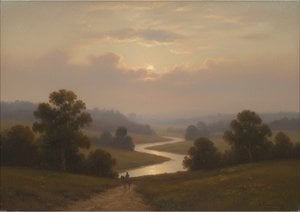
The Quiet Mastery of David van Oven
In the annals of late nineteenth-century European painting, few names evoke the serene, atmospheric stillness of the era quite like David van Oven. Born in 1852, Van Oven emerged during a transformative period in art history, a time when the rigid structures of academicism were beginning to soften under the influence of light and fleeting moments. His life and work serve as a window into a world where the boundaries between reality and impression were delicately blurred, capturing the soul of the landscape through a lens of profound tranquility.
The essence of Van Oven’s artistry lies in his ability to command the subtle nuances of light and shadow. Unlike the more boisterous movements that sought to shock the viewer with vibrant, clashing pigments, Van Oven preferred a more contemplative palette. His canvases often breathe with a muted, earthy elegance, utilizing tones that suggest the dampness of a morning mist or the golden, receding glow of a late autumn afternoon. Through his brush, the viewer is not merely looking at a scene, but is invited to inhabit it, feeling the weight of the air and the quietude of the natural world.
Technique and Artistic Vision
To study a Van Oven original is to witness a masterclass in texture and atmospheric perspective. His technique was characterized by a deliberate, thoughtful application of paint that prioritized the emotional resonance of a scene over mere topographical accuracy. He possessed an uncanny ability to render the translucency of water and the heavy, tactile quality of foliage, creating a sense of depth that pulls the observer into his painted realms.
His development as an artist was marked by several key artistic pillars:
- Atmospheric Depth: The use of soft edges and hazy horizons to create a sense of infinite space.
- Luminosity: A focus on how natural light interacts with various surfaces, from the sheen of a river to the matte texture of stone.
- Compositional Harmony: A balanced approach to landscape elements that guides the eye through a rhythmic, peaceful journey across the canvas.
Legacy and Historical Significance
As the nineteenth century drew to a close and moved into the twentieth, the art world underwent radical shifts toward abstraction and expressionism. While many of his contemporaries chased the avant-garde, David van Oven remained a steadfast guardian of the evocative landscape. His work stands as a testament to the enduring power of representational beauty and the profound emotional impact of the natural environment.
Today, Van Oven’s legacy is preserved through his contributions to the tradition of European landscape painting. He remains a significant figure for collectors and historians alike, representing a bridge between the classical mastery of the past and the sensory-focused explorations of the modern era. His paintings continue to offer a sanctuary of peace, reminding us of a time when art sought to capture the eternal, quiet rhythms of the earth.
Q&A
David van Oven의 작품은 얼마나 인기가 있나요?
이 사이트에서 David van Oven의 작품에 관한 통계를 확인할 수 있는 방문 통계 페이지를 만나보세요.
David van Oven 작가의 작품을 감상할 수 있는 3D 갤러리는 어디인가요?
가상 방문이 가능합니다: David van Oven의 3D 갤러리 페이지에서 3D 갤러리를 통해 작가의 작품들을 만나보실 수 있습니다.
David van Oven은(는) 어느 시대의 작품을 남겼나요?
David van Oven은(는) 19th Century 시대에 활동했습니다. 이 시기는 역사적 맥락 속에서 작가의 예술적 위치를 보여줍니다.
David van Oven의 작품을 분위기별로 모아둔 곳은 어디인가요?
아티스트의 무드 룸 페이지에서는 David van Oven의 작품들을 분위기에 따라 큐레이션된 형태로 만나보실 수 있습니다.