The Man Behind the Pseudonym
London, 1853. A child named Joseph Donahue enters a world of modest means, the fourth of many children born to a London porter and an Irish mother. His early years lack the formal structure of an academy, a void that eventually becomes his greatest strength. He spends his youth sketching on the streets of London, earning a meager living through the sheer grit of observation. By his twenties, a shift occurs. He moves to Dalston, Cumbria, and adopts a new identity: David James. This name becomes a shield and a brand, separating the man from the artist as he seeks a life defined by the sea rather than the struggle of the city.
A German-born picture dealer recognizes the raw potential in these sketches. This patronage provides the stability required to move beyond street sketching and into the serious study of oil. He settles in Plymouth during the 1880s, positioning himself as a dedicated observer of the coastline stretching from Cornwall to the Thames estuary. He is not interested in the geography of the land or the specific landmarks of a coast. Instead, he pursues the movement of the water itself.
The Mechanics of the Atlantic
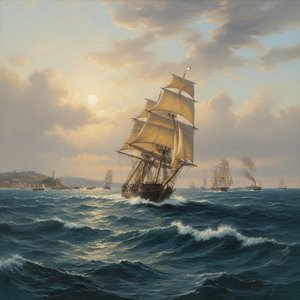
James focuses on the physics of the swell. His work centers on the tension of breaking waves and the heavy, churning energy of the Atlantic. He works almost exclusively in oil, using the medium to build the thick, luminous textures required to mimic salt spray and deep currents. His compositions prioritize the emotional weight of the ocean over topographical accuracy. He seeks the essence of the tide, often ignoring the shore to focus on the white foam and the dark, heavy weight of a rolling swell.
His technical focus remains consistent across several key subjects:
- The heavy, breaking swells of the Atlantic rollers.
- The shifting light of Cornish coastal scenes.
- The rhythmic movement of tides in the Isles of Scilly.
- The interaction of wind and water in mid-channel settings.
Exhibition and Legacy
The Royal Academy recognizes his skill, hosting his works between 1886 and 1897. His presence in these prestigious exhibitions cements his status within the Victorian marine tradition. He becomes a specialist of the shore, known for capturing the sea from the perspective of the coast looking out into the chaos of the breakers. His signature, D. James, appears on works that document the raw power of the natural world, such as A North Cornish Breaker and An Atlantic Roller.
His life ends in 1892, leaving behind a body of work that remains a specific study in marine specialization. While his biography remains somewhat unresolved, his paintings remain held in significant collections, including the National Maritime Museum. He remains a painter of the water, a man who traded a common name for a life submerged in the study of the sea.
Q&A
David James의 다른 이름이나 별칭에는 무엇이 있나요?
David James은(는) Давид Джеймс라는 이름으로도 활동하고 있습니다.
주제별로 분류된 David James의 작품들은 어디에서 확인할 수 있나요?
David James의 작품은 작가의 주제별 작품 모음 페이지에서 주제별로 찾아보실 수 있습니다.
David James 작가의 작품을 연도별로 어떻게 확인할 수 있나요?
David James의 작품을 연도별로 정리하여 보여주는 작품 연대기 페이지입니다.
David James 작가의 작품에서 가장 자주 나타나는 색상은 무엇인가요?
David James 작가 작품의 컬러 프로필은 작가의 팔레트 지놈 페이지에서 확인하실 수 있습니다.