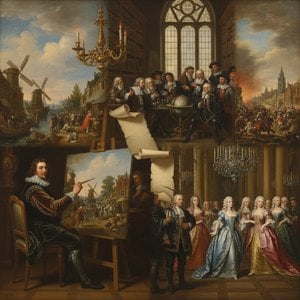
The Swift Brush of Delft: The Life and Legacy of David Beck
In the golden era of Dutch portraiture, few names evoke as much wonder regarding technical prowess and sheer velocity as David Beck. Known to his contemporaries simply as Beek, this master of the seventeenth century possessed a rare, almost supernatural ability to translate the human soul onto canvas with breathtaking speed. Born in the illustrious city of Delft on May 25, 1621, Beck was a child of profound artistic lineage. He carried the intellectual weight of an uncle who was a celebrated poet from Arnhem, a connection that likely fostered his deep appreciation for the marriage of visual elegance and literary depth. Raised by a father who served as a schoolmaster, Beck’s early education was steeped in the disciplined observation required of a true master.
His formative years were defined by the mentorship of Michiel Jansz. van Mierevelt, a titan of Delft portraiture. Under Van Mierevelt’s tutelage, Beck mastered the intricate nuances of light and shadow, learning to capture not just the physical likeness of his subjects, but their very essence. This foundation allowed him to develop a style characterized by an unparalleled ability to seize fleeting expressions and movements. It was this remarkable efficiency that earned him legendary status; even Anthony van Dyck, one of the greatest painters of the age, famously remarked upon Beck's rapid execution, suggesting with playful awe that the artist could perhaps paint while riding post.
A Journey Through Royal Courts
The trajectory of Beck’s career took a dramatic turn in 1640 when he traveled to London. His intention was to join the studio of Van Dyck as a pupil and assistant, a move that promised to place him at the very heart of European artistic innovation. However, fate intervened with tragic timing; shortly after his arrival, Van Dyck fell ill and passed away, leaving Beck to navigate the shifting political landscape of England on his own. Despite this loss, his talent was impossible to ignore. The English court, under Charles I, recognized his extraordinary "freedom of hand." In a moment that cemented his reputation among the elite, Charles I himself was so impressed by Beck's expeditious manner that he requested the artist teach drawing to his sons, including the future Charles II and James II.
As the tremors of the English Civil War reshaped the continent, Beck’s artistry became a vessel for diplomacy and prestige. He transitioned from the halls of London to the grand courts of Europe, eventually finding himself in the service of Queen Christina of Sweden. In 1647, he was appointed portrait painter and valet de chambre to the Queen in Stockholm. This period marked one of his most significant achievements, as he executed magnificent portraits of European sovereigns to adorn her royal gallery. His travels were not merely artistic but political, as Christina often utilized Beck’s presence on her tours through Europe to bolster her influence.
The Final Act and Enduring Impression
Beck's life was a whirlwind of movement, much like the brushstrokes that defined his work. His later years saw him navigating the complexities of the European courts, moving from Stockholm to Rome, and eventually following Queen Christina to France. His life was marked by near-miraculous resilience; during a period of illness in Germany, he was even thought to have died and prepared for burial, only to revive and return to his duties. Yet, the same intensity that fueled his creativity seemed to exhaust his physical form. His death at The Hague in 1656 remains shrouded in the shadows of history, with whispers of poisoning adding a layer of tragic mystery to his passing.
The historical significance of David Beck lies in his ability to bridge the gap between the meticulous traditions of the Dutch masters and the more fluid, expressive style of the Baroque era. His work stands as a testament to:
- Technical Virtuosity: The rare ability to maintain high artistic standards while working with unprecedented speed.
- Royal Influence: A career that directly shaped the artistic education of future English monarchs.
- Cultural Diplomacy: Using portraiture as a tool for connection between the most powerful figures of the seventeenth century.
Today, when we look upon the portraits attributed to Beck, we do not merely see faces of the past; we see the captured energy of a man who lived and painted with a velocity that few could ever hope to match.
Q&A
David Beck 작품의 연도별 타임라인이 있나요?
David Beck의 작품을 연도별로 정리하여 보여주는 작품 연대기 페이지입니다.
키워드별로 분류된 David Beck의 작품은 어디에서 볼 수 있나요?
특정 주제의 David Beck 작품을 찾으려면 키워드별로 작품이 분류된 작가의 키워드별 탐색 페이지를 이용해 보세요.
David Beck의 작품 중 몇 점을 둘러보실 수 있나요?
전체 작품 보기 페이지에서 David Beck의 작품 작품 13점점을 만나보실 수 있습니다.
David Beck은(는) 어느 시대의 작품을 남겼나요?
David Beck은(는) Early Modern 시대에 활동했습니다. 이 시기는 역사적 맥락 속에서 작가의 예술적 위치를 보여줍니다.