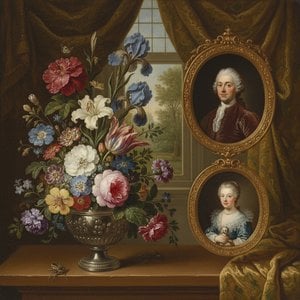
The Master of Light and Line: The Life of Cornelis Cels
In the grand tapestry of nineteenth-century Flemish art, few threads are woven as delicately as those left by Cornelis Cels. Born in 1778 in the historic town of Lier, Belgium, Cels emerged from a prominent local family to become a painter whose work bridged the gap between the structured elegance of the past and the emotive, atmospheric sensibilities of the Romantic era. His journey was one of profound movement—from the studios of Flanders to the sun-drenched landscapes of Italy and the prestigious courts of The Hague—each destination adding a new layer of depth to his artistic vision.
Cels’s early education was marked by a rigorous pursuit of technical mastery. He began his training under the sculptor Pompe, before moving toward the more fluid world of painting under P.-J. Denis. However, it was his period of study from 1795 to 1800 under the renowned Antwerp painter Andries Cornelis Lens that truly forged his identity. Under Lens, Cels absorbed the principles of Neoclassicism and the revival of classical traditions, a foundation that would later allow him to execute religious and historical subjects with unparalleled dignity and grace.
A Journey Through Europe: From Rome to The Hague
The trajectory of Cels’s career was profoundly shaped by his travels, which served as an extended masterclass in the European tradition. In 1800, he ventured to Paris, working under the Classicist Joseph-Bensît Suvée, before embarking on a transformative seven-year residency in Italy. It was in Rome that Cels truly encountered the sublime. His talent was so immediately apparent that his work, Cincinnatus, won the golden prize at the competition of the Academy of Ghent, and he was subsequently admitted as a member and professor of the prestigious Accademia di San Luca.
During these Roman years, Cels undertook significant religious commissions, often tasked with creating works to replace masterpieces by Rubens that had been lost or confiscated during the French occupation. This period of intense spiritual and historical engagement solidified his reputation as a painter capable of handling both the monumental and the intimate. Upon returning to Flanders and eventually settling in The Hague in 1815, he found himself under the patronage of the royal court, where his ability to capture the refined essence of the aristocracy made him a sought-after portraitist.
The Synthesis of Portraiture and Emotion
While Cels is celebrated for his religious subjects, it is in his portraiture that we see the true evolution of his style. He possessed a rare ability to marry the Mannerist elegance of his predecessors with a burgeoning Impressionistic sensitivity. His portraits are not merely static records of likeness; they are studies in character and atmosphere. Through the masterful use of chiaroscuro—the dramatic interplay of light and shadow—he imbued his subjects with a palpable sense of life and psychological depth.
His notable works serve as windows into the era's social fabric:
- Swiss Peasant Woman (1820-1821): A masterpiece of realism that showcases his commitment to naturalistic observation, capturing the rugged beauty of rural life through meticulous detail.
- Aryna van der Pot (1841): A portrait that exemplifies his ability to render fine textures and soft light, presenting a dignified and serene presence.
Ultimately, the legacy of Cornelis Cels lies in his role as a pivotal conduit between eras. He carried the weight of Flemish tradition—the grandeur of Rubens and the precision of the Academies—into a new age of observation. As a professor and director of the Académie des Beaux-Arts de Tournai, he also ensured that this lineage of excellence would continue through future generations, leaving behind a body of work that remains a testament to the enduring power of light, shadow, and the human spirit.
Q&A
주제별로 분류된 Cornelis Cels의 작품들은 어디에서 확인할 수 있나요?
Cornelis Cels의 주제별 작품 모음는 작가의 작품들을 주제별로 찾아볼 수 있는 페이지입니다.
Cornelis Cels의 모든 작품은 어디에서 볼 수 있나요?
이 사이트에 등록된 Cornelis Cels의 모든 작품은 작가의 전체 작품 보기 페이지에서 만나보실 수 있습니다.
Cornelis Cels의 작품 중 몇 점을 둘러보실 수 있나요?
전체 작품 보기 페이지에서 Cornelis Cels의 작품 작품 25점점을 만나보실 수 있습니다.