A Life in Two Frames
Bill Page lived a life defined by the dualities of the studio and the lens. Born in the United States of America in 1925, he spent his early years developing an eye for the nuances of form before eventually settling in Brooklyn, New York. While many recognize him through the thick impasto and layered energy of works like Mexico Cathedral Interior, his presence in the art world was equally felt through his work behind a camera. He moved to New York City in 1982, a period that marked a significant shift in his professional focus.
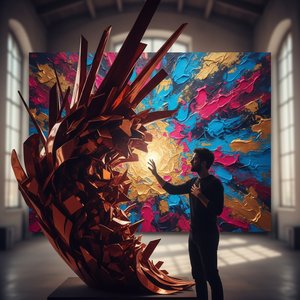
His painting style found its footing within Abstract Expressionism. In his canvases, color and motion are not merely applied but built up, creating a physical presence on the surface. This approach to the medium allowed him to explore the weight of paint itself. His work often sought to capture the spirit of American Abstraction, a movement that deeply informed his visual language.
The Documentarian's Eye
By the 1980s, Page began to extend his gaze beyond his own canvases, turning toward the lives of other painters. He became a filmmaker, dedicating four decades to documenting the process of creation within the studio. This work was not about the finished product hanging on a gallery wall, but about the quiet, often solitary moments of making. His films sought to bring the viewer into the private spaces where art is born.
His filmography reflects a deep commitment to the abstract tradition. Through his direction and production, he captured the voices of significant contributors to the art world, focusing on those whose work echoed the aesthetic qualities of the 1940s. His subjects included figures such as:
- Larry Poons
- Judy Pfaff
- Rodney Dickson
- Pat Passlof
A Legacy of Observation
Page’s career was characterized by a steady, observant presence. He exhibited his work extensively throughout the United States before establishing himself in the East Village scene of New York. Even as his documentary work received critical acclaim, he remained rooted in the practicalities of the artist's life. He understood that seeing an artist speak in their own words could offer a dimension of understanding that a static image cannot provide.
He passed away in 2017, leaving behind a body of work that spans both the tactile world of oil paint and the moving image. His contribution remains tied to the preservation of the studio experience, ensuring that the dialogue between the painter and their medium was recorded for those who follow.