Beryl Fowler: A Cumbrian Visionary of Rural Life
Beryl Fowler (1881-1963), born Mary Beryl Menzies in Newcastle upon Tyne, was more than simply an English painter; she was a keen observer and devoted chronicler of the rugged beauty and enduring traditions of rural Cumbria. Her legacy resides not just in the canvases that bear her name – predominantly evocative landscapes and intimate portraits – but also in her ability to capture the very soul of a vanishing way of life, a testament to the power of observation and a deep connection with the land.
Fowler’s artistic journey began under the tutelage of Hubert von Herkomer at his prestigious Art School in Bushey, Hertfordshire. This formative period instilled within her a classical approach to painting, emphasizing anatomical accuracy and meticulous detail – qualities that would later inform her masterful depictions of figures and their surroundings. However, it was her relocation to Cumbria, coupled with her marriage to the fellow artist Francis “Frank” Hugh Fowler, that truly ignited her artistic passion. The couple settled in Eskdale, a remote valley nestled within the fells, providing them with unparalleled access to the subject matter that would define her career.
The Landscape of Memory
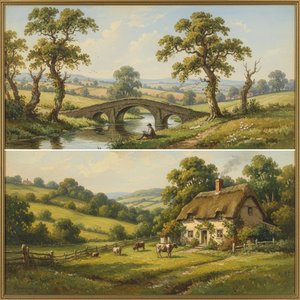
Fowler’s paintings are overwhelmingly dominated by scenes from Cumbrian life – the rolling hills, the dramatic fells, the winding valleys, and the humble dwellings scattered across the landscape. She wasn't interested in grand vistas or romanticized depictions; instead, she focused on the everyday rhythms of rural existence: shepherds tending their flocks, farmers working the land, villagers engaged in their daily routines. Her palette was deliberately muted – earthy browns, greens, greys, and ochres – reflecting the natural tones of her surroundings and lending a sense of timelessness to her work. The light, often diffused by the ever-present mist, played a crucial role, creating an atmosphere of quiet contemplation and reinforcing the connection between humanity and nature.
Her technique was characterized by a remarkable sensitivity to texture and form. She employed loose, expressive brushstrokes that captured the rough surfaces of stone walls, the tangled growth of hedgerows, and the weathered faces of her subjects. There’s a palpable sense of immediacy in her paintings – as if she were capturing a fleeting moment, a transient impression of the landscape or its inhabitants.
Portraits of Character
Alongside her landscapes, Fowler produced a series of compelling portraits that offered intimate glimpses into the lives of Cumbrian villagers. These weren’t idealized representations; they were honest and unvarnished studies of character, capturing the wrinkles etched by time, the shrewdness in their eyes, and the quiet dignity of those who had spent their lives working the land. She skillfully used light and shadow to sculpt her subjects' faces, revealing both their physical features and their inner personalities. The portraits are imbued with a profound sense of empathy and respect for the individuals she depicted.
Influences and Legacy
While influenced by the classical traditions of Herkomer’s school, Fowler developed a distinctly individual style – one that was deeply rooted in her experience of Cumbria. Her work can be seen as part of a broader movement to document and celebrate rural life in Britain during the late 19th and early 20th centuries. The Laing Art Gallery in Newcastle, the Armitt Museum and Library, and the Beacon Museum in Whitehaven all proudly display her paintings, ensuring that her evocative visions of Cumbrian life continue to resonate with audiences today.
Beryl Fowler’s legacy extends beyond the individual artworks she created. She served as a vital link between the past and present, preserving a record of a disappearing world and offering us a poignant reminder of the enduring beauty and resilience of rural England. Her paintings are not merely representations of landscapes and people; they are windows into a way of life that is increasingly rare – a testament to the power of observation, empathy, and artistic vision.
Q&A
Beryl Fowler의 작품을 분위기별로 모아둔 곳은 어디인가요?
Beryl Fowler의 무드 룸에서는 작가의 작품들을 분위기별로 만나보실 수 있습니다.
Beryl Fowler의 작품 중 조회수가 가장 높은 것은 무엇인가요?
Beryl Fowler 작가의 작품 통계 정보는 방문 통계 페이지에서 확인하실 수 있습니다.
Beryl Fowler의 작품 중 몇 점을 둘러보실 수 있나요?
전체 작품 보기 페이지에서 Beryl Fowler의 작품 작품 22점점을 만나보실 수 있습니다.
주제별로 Beryl Fowler의 작품을 찾아볼 수 있나요?
Beryl Fowler의 주제별 작품 모음는 작가의 작품들을 주제별로 찾아볼 수 있는 페이지입니다.