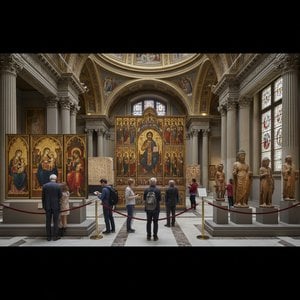
Bernat Martorell: The Soul of Catalan Gothic
Bernat Martorell, a name synonymous with the flourishing artistic scene of 15th-century Barcelona, stands as a pivotal figure in Spanish art history. More than just a painter, he was a master of visual storytelling, a conduit between religious fervor and meticulous detail, and ultimately, the defining voice of International Gothic style within Catalonia. Born around 1400 in Sant Celoni, and tragically dying in Barcelona in 1452, Martorell’s life spanned a period of immense artistic transformation, and his legacy continues to resonate through the intricate altarpieces and illuminated manuscripts that bear his distinctive mark.
Early biographical details remain frustratingly sparse. We know little about his formative years before approximately 1427, yet by mid-century he was already recognized as a leading artist in Catalonia. His style diverged significantly from the preceding Catalan Gothic tradition, showcasing an awareness of contemporary Flemish painting—a remarkable feat considering the geographical distance and relative isolation of the region. This influence, however, doesn’t diminish his uniquely Catalan identity; rather, it suggests a sophisticated artistic sensibility deeply rooted in both local traditions and broader European trends. The documented portion of his life reveals a man who was constantly innovating, pushing the boundaries of what was possible within the established artistic framework.
A Master of Altarpiece Design
Martorell’s most enduring contribution lies in his masterful creation of altarpieces – monumental panels designed to dominate church interiors and narrate biblical stories. These weren't merely decorative; they were immersive experiences, intended to inspire devotion and educate the faithful. His work is characterized by a dramatic intensity, a palpable sense of movement, and an astonishing level of detail. Consider, for example, the *Retable of Saint John the Baptist* from Cabrera de Mar, currently housed in the Museu Diocesà de Barcelona – a testament to his skill and meticulous approach. The intricate drapery, the expressive faces, and the vibrant colors all contribute to a scene brimming with life and emotion.
Perhaps his most famous work is *Saint George and the Dragon*, now residing at the Art Institute of Chicago. Painted around 1434-1435, this tempera on panel depicts the legendary battle between Saint George and the dragon, a potent symbol of Christian virtue triumphing over evil. The composition is dynamic and engaging, with Saint George poised to strike the final blow. The painting’s influence extends beyond its immediate narrative; it exemplifies Martorell's ability to infuse religious iconography with a sense of immediacy and drama—a hallmark of his style.
Beyond the Altarpiece: Illuminated Manuscripts and Sculptural Contributions
Martorell’s artistic output extended far beyond the realm of altarpieces. He was also a skilled illuminator, contributing to the creation of richly decorated manuscripts – books that were considered objects of immense beauty and value. His illuminated pages are characterized by their vibrant colors, intricate details, and expressive figures. Furthermore, he engaged in sculptural work, designing decorative elements for embroideries—demonstrating his versatility as a multi-faceted artist.
The *Retable of Saint Pere de Púbol*, commissioned in 1437, stands as a prime example of his work on a grand scale. This altarpiece, dedicated to Saint Peter, is currently housed in the Museu d'Art de Girona and represents a pivotal moment in Martorell’s career. It showcases his ability to create complex compositions that effectively convey religious narratives while simultaneously demonstrating technical mastery.
Influence and Legacy
Bernat Martorell’s impact on Catalan art is undeniable. He served as an influential mentor, shaping the work of subsequent generations of artists. His style—characterized by its dramatic intensity, meticulous detail, and innovative use of color—became a defining feature of International Gothic painting in Catalonia. His work continues to be studied and admired for its artistic merit and historical significance.
While much about his life remains shrouded in mystery, Bernat Martorell’s legacy endures as one of the most important artists of the 15th century. He was a true innovator, a master storyteller, and a vital contributor to the rich artistic heritage of Spain. His altarpieces and illuminated manuscripts offer a glimpse into a world of faith, beauty, and enduring artistry.
질의응답
미술 사조별로 분류된 Bernat (Bernardo) Martorell의 작품은 어디에서 볼 수 있나요?
Bernat (Bernardo) Martorell 작가가 활동했던 예술 사조는 작품을 사조별로 분류하여 보여주는 작가의 모든 사조 페이지에서 확인하실 수 있습니다.
Bernat (Bernardo) Martorell의 작품 중 조회수가 가장 높은 것은 무엇인가요?
Bernat (Bernardo) Martorell 작가 작품에 관한 통계 정보는 작가의 통계 페이지에서 확인하실 수 있습니다.
Bernat (Bernardo) Martorell 작품의 연도별 타임라인이 있나요?
Bernat (Bernardo) Martorell의 작품 연표를 확인해 보세요: 작품 연대기 페이지에서 작품들을 제작 날짜순으로 보실 수 있습니다.