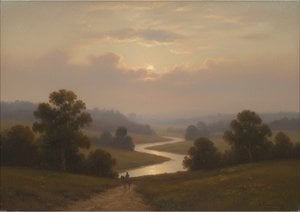
The Quietude of New England
The landscape of North Anson, Maine, provides the initial backdrop for a life defined by a slow, deliberate pursuit of light and shadow. Born in 1852, Benjamin Foster does not enter the art world with the suddenness of a prodigy. Instead, he navigates the practicalities of survival, working as a merchant to fund a late-blooming devotion to the canvas. By the 1870s, the focus shifts to New York City. Here, the atmosphere of the Art Students League begins to shape his vision under the guidance of Abbott Thayer. The influence of Thayer manifests in a specific sensitivity to floral still life, a precision that would later settle into the broader, more atmospheric compositions of his mature years.
The transition from the mercantile to the aesthetic is not a leap, but a steady migration. By the 1880s, the scene moves to Paris. The air of the French capital offers a different kind of rigor. Studying under Luc-Olivier Merson, Harry Thompson, and Aimé Morot, Foster absorbs the technical discipline required for the Paris Salon. He moves through the French countryside and the environs of Barbizon, absorbing the weight of the atmosphere before returning to the United States. This period marks the hardening of his intent, a movement away from mere representation toward a specific, tonalist sensibility.
The Tonalist Palette
Foster’s work finds its true home in the quiet corners of the American landscape. He avoids the frantic energy of plein air painting, preferring the controlled environment of his studio to refine the mood of a scene. His focus settles on the New England countryside, specifically the rolling hills and wooded areas of Connecticut. The colors are never loud; they are muted, restrained, and deeply specific to the changing seasons.
- A preference for autumnal hues, utilizing rust, gray, and deep brown tones.
- The depiction of specific times of day, such as dawn and dusk.
- A focus on bucolic scenes including forests, fields, and ponds.
- The use of oil and watercolor to achieve soft, atmospheric effects.
His technique relies on a limited palette to evoke a sense of stillness. In works like In the Connecticut Hills, the light does not strike the landscape so much as it settles upon it. This approach creates a sense of solitude, capturing the essence of the New England terrain without the distraction of high-contrast drama.
Legacy and Recognition
The significance of Foster’s contribution lies in his commitment to a specific, poetic vision of the American landscape. He was an artist who sought deeper meanings in the subtle shifts of light and color, remaining indifferent to the more popular or casual trends of his era. His presence in major collections confirms the lasting weight of his quiet observations. His works reside in the following institutions:
By the time of his death in 1926, Foster had established himself as a definitive voice in American Tonalism. He left behind a body of work that serves as a record of a specific, atmospheric way of seeing the world, where the landscape is not merely a subject, but a mood captured in oil and pigment.
Q&A
Ben Foster의 작품을 색상별로 찾아볼 수 있나요?
Ben Foster의 작품은 작가의 컬러 인덱스 페이지에서 색상별로 감상하실 수 있습니다.
Ben Foster의 작품 중 조회수가 가장 높은 것은 무엇인가요?
Ben Foster 작가의 작품 통계 정보는 방문 통계 페이지에서 확인하실 수 있습니다.
Ben Foster은(는) 어느 시대의 작품을 남겼나요?
Ben Foster은(는) 19th Century 시대에 활동했습니다. 이 시기는 역사적 맥락 속에서 작가의 예술적 위치를 보여줍니다.
Ben Foster 작품의 연도별 타임라인이 있나요?
Ben Foster의 작품 연표를 확인해 보세요: 작품 연대기 페이지에서 작품들을 제작 날짜순으로 보실 수 있습니다.