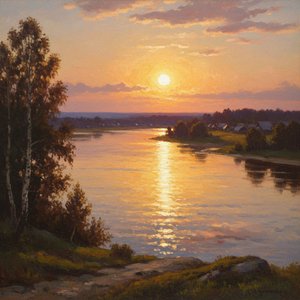
The Quiet Observer of Estonian Life
August Pulst was a man of many layers, a figure whose life was deeply intertwined with the cultural fabric of Estonia. Born in 1889 in Kiisa, Pärnumaa, his early years were shaped by the rural landscapes of the Estonian countryside. He was a man of profound curiosity, a trait that led him from the quietude of his birthplace to the academic halls of the Riga Art School. Under the guidance of V. Purvītis, he refined his technical skills, eventually earning the title of Drawing Teacher. His life was not merely a pursuit of aesthetics; it was a dedicated effort to preserve the vanishing echoes of his homeland through the collection of folk music and antiques.
The shifting tides of history eventually pulled him from Latvia toward Tallinn. This transition marked a significant chapter in his professional life, as he moved from the academic study of art to the practical, often demanding world of scenography. As a theater decorator, he learned to manipulate space and light, a skill that would later inform his visual compositions. His work was characterized by a deep connection to his immediate surroundings, finding profound meaning in the mundane details of everyday existence.
A Life of Diverse Pursuits
Pulst’s contributions to Estonian culture were multifaceted, extending far beyond the canvas. He was a man who sought to build institutions even as he practiced his craft. His interests were broad and his impact was felt in several distinct areas:
- The preservation of folk culture through the collection of music and antiques.
- The development of theatrical landscapes as a scenographer and decorator.
- The establishment and management of significant cultural institutions, including the Estonian Art Museum and the Estonian Theatre and Music Museum.
- The founding of the Tori Museum.
His artistic development saw him move through different mediums and moods. While he began with a focus on impressionism in oils, his later years were defined by a mastery of watercolors. He possessed a particular ability to capture the essence of Tallinn, often working with a specific palette of blue and red to define the city's character. His subjects were the people and places that defined his reality: the hardworking villagers, the stillness of nature, and the movement of urban life.
The Legacy of a Cultural Architect
By the second half of the 20th century, Pulst had become a fixture of the Estonian art community. He was a productive painter who participated in numerous exhibitions, often focusing on the delicate nuances of watercolor. His work was not an attempt to escape reality, but an effort to document it. Whether he was painting the Merivälja neighborhood or a tranquil landscape, his focus remained on the tangible world around him.
He died in Tallinn in 1977, leaving behind a body of work that remains held in the Estonian Art Museum and various private collections. His significance lies not only in the paintings he produced but in the museums he helped build. He was a man who understood that for art to survive, it requires more than just talent; it requires the structure of institutions and the careful preservation of the past.
Q&A
August Pulst의 작품을 색상별로 모아둔 곳은 어디인가요?
August Pulst의 컬러 인덱스에서는 작가의 작품들을 색상별로 모아 보실 수 있습니다.
August Pulst의 작품을 연도순으로 어디에서 볼 수 있나요?
August Pulst의 작품 연표를 확인해 보세요: 작품 연대기 페이지에서 작품들을 제작 날짜순으로 보실 수 있습니다.
August Pulst의 작품을 사조별로 둘러볼 수 있나요?
August Pulst의 작품은 작가의 모든 미술 사조 페이지에서 사조별로 만나보실 수 있습니다.
August Pulst의 작품 중 조회수가 가장 높은 것은 무엇인가요?
이 사이트에서 August Pulst의 작품에 관한 통계를 확인할 수 있는 방문 통계 페이지를 만나보세요.