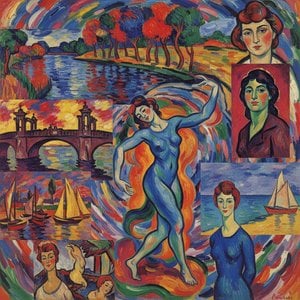
The Life and Legacy of Arthur Midy
Born in the historic town of Saint-Quentin on March 18, 1877, Arthur Midy emerged as a painter whose life was as dramatically textured as the landscapes he so lovingly captured. The son of a joiner, Midy’s early years were marked by an extraordinary precocity in the arts. His journey began at the École Quentin de La Tour, where his burgeoning talent earned him a silver medal in 1889 and prestigious bursaries that allowed him to pursue formal training at the Henri Martin School and later the renowned Paris École des Beaux-Arts. By enrolling in the Académie Julian in 1900, Midy placed himself within the heart of the French academic tradition, honing a technique that would eventually allow him to master both the delicate nuances of genre painting and the rugged beauty of the natural world.
The trajectory of Midy’s career was profoundly shaped by his deep connection to the French countryside, particularly the enchanting region of Brittany. In 1905, a discovery that would redefine his artistic soul, he encountered the landscapes of Faouët. This encounter led him to establish a residence there between 190 and 1909, a period during which his work began to breathe with the light and atmosphere of the Breton terrain. His ability to translate the essence of local life—from the sun-drenched effects of a fair day to the quiet dignity of market women—earned him significant recognition. A pivotal moment in his professional ascent occurred in 1909, when the French Government purchased his evocative work, Le vieux buveur, from the Salon, signaling his arrival as an artist of national importance.
Artistic Vision and Mastery
Midy’s oeuvre is a testament to his versatility as a landscape and genre painter. His brushwork often sought to capture the fleeting interplay of light and shadow, a skill evident in works such as Effet du soleil, un jour de foire. He possessed a unique ability to blend the pastoral with the human element, creating scenes where the environment and its inhabitants exist in a seamless, rhythmic harmony. His subjects ranged from the architectural reverence of the La Fontaine Sainte-Barbe au Faouët to the intimate, everyday struggles and joys found in his Breton market scenes.
Beyond the canvas, Midy’s life was marked by a complex intersection of art and history. During the tumultuous years of the First World War, he applied his eye for detail and preservation to the monumental task of restoring and organizing the repatriation of artworks taken during the conflict. However, the later chapters of his life were shadowed by the political tensions of the Second World War. His marriage to a German woman, Emilie Maïer, in 1938 placed him in a precarious position amidst the occupation. This tragic entanglement with the occupying forces led to his assassination by the French Resistance in Le Faouet on March 8, 1944.
Though his life ended in violence, the artistic legacy of Arthur Midy remains preserved through the works that continue to inhabit museums such as the Musée des Beaux-Arts de Quimper. His contributions to French painting serve as a poignant reminder of an artist who sought to find the eternal within the ephemeral moments of rural life.
Q&A
Arthur Midy의 출생 도시와 국가는 어디인가요?
Arthur Midy은(는) France Saint-Quentin에서 태어났습니다.
Arthur Midy의 모든 작품은 어디에서 볼 수 있나요?
이 사이트에 등록된 Arthur Midy의 모든 작품은 작가의 전체 작품 보기 페이지에서 만나보실 수 있습니다.
Arthur Midy 작가의 작품을 감상할 수 있는 가상 박물관에 방문할 수 있나요?
Arthur Midy의 작품은 작가의 3D 갤러리 페이지 내 3D 갤러리에서 감상하실 수 있습니다.
Arthur Midy의 출생지와 출생 연도는 어떻게 되나요?
Arthur Midy은(는) 1887년 Saint-Quentin에서 태어났습니다.