The Soul of the Russian Landscape: The Life of Arkady Rylov
To wander through the canvases of Arkady Aleksandrovich Rylov is to embark on a spiritual pilgrimage through the heart of the Russian wilderness. Born in 1870 in the quiet village of Istobensk, within the Vyatka Governorate, Rylov’s early life was shaped by a profound sensitivity to the world around him—a sensitivity perhaps deepened by the personal hardships of his youth, including the mental illness of his father. This early exposure to the complexities of human emotion and the raw beauty of nature laid the foundation for an artistic vision that would eventually transcend mere landscape painting to become a cornerstone of the Russian Symbolist movement.
Rylov’s formal training was as rigorous as it was transformative. He began his studies at the Technical Design School of Baron Shtiglitz, but it was his transition to the Imperial Academy of Arts that truly ignited his creative spirit. Under the mentorship of the legendary Arkhip Kuindzhi, Rylov learned to manipulate light and shadow, discovering how a single brushstroke could evoke the weight of an approaching storm or the ethereal glow of a spring morning. Alongside contemporaries like Konstantin Korovin, he refined a technique that blended the precision of realism with the emotive, atmospheric qualities of Impressionism.
Symbolism in Nature: Beyond the Visible Horizon
While Rylov’s early repertoire included historical compositions such as “Assault of Pechenegs on a Slav Village,” his true calling lay in the quietude of the natural world. As the political landscape of Russia shifted through the turbulence of the October Revolution, Rylov’s work became an anchor of symbolic resonance. His landscapes were never just topographical records; they were vessels for the collective anxieties and yearnings of a nation in flux. In his hands, a birch tree or a flowing river became symbols of endurance, purity, and spiritual renewal.
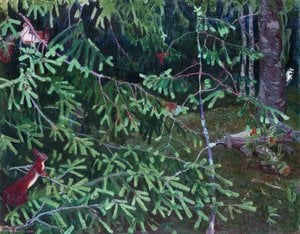
This deep connection to the living world extended into his very studio environment. Rylov famously kept a menagerie of wildlife—squirrels, rabbits, and even a monkey named Manka—within his workspace. This intimate communion with animals fostered an unparalleled ability to capture the pulse of life within his paintings. As the artist Mikhail Nesterov once observed, these creatures served as symbols of tranquility, providing a sanctuary of peace amidst the chaotic societal transformations occurring outside his windows.
Masterpieces and Lasting Legacy
The zenith of Rylov’s career is marked by works that remain etched in the annals of art history for their evocative power. “Green Noise” (1904) stands as a definitive masterpiece of the Symbolist aesthetic, utilizing vibrant, impressionistic textures to depict a springtime landscape where Slavic ships appear on the distant horizon, suggesting a harmony between man and the infinite. Similarly, “Blue Expanse” (1918) captures a sense of boundless possibility and the sublime scale of the Russian sky.
Throughout his life, Rylov’s contributions to the graphic arts and landscape painting left an indelible mark on the Soviet and Russian artistic consciousness. His ability to weave together the following elements defines his historical significance:
- The Synthesis of Styles: The seamless integration of Realist detail with Symbolist emotion and Impressionistic light.
- National Identity: A profound dedication to capturing the unique essence, folklore, and atmosphere of the Russian landscape.
- Emotional Depth: The use of nature as a metaphor for the human condition, reflecting both the serenity of peace and the turbulence of revolution.
When Arkady Rylov passed away in 1939 in Leningrad, he left behind a body of work that continues to breathe with the vitality of the earth itself. His paintings remain more than just art; they are windows into a soul that found divinity in the rustle of leaves and the vast, blue expanse of the horizon.
Q&A
Arkady Rylov 작가의 다른 활동명이나 알려진 이름이 있나요?
Arkady Rylov은(는) Arkady Alexandrovich Rylov, Arkadij Alexandrovitsch Ryloff, Arkady Aleksandrovich Rylov, Arkadij Aleksandrovič Rylov, Arkadi Aleksandrovich Rylov(으)로도 알려져 있습니다.
특정 색상 팔레트의 Arkady Rylov 작품은 어디에서 찾아볼 수 있나요?
Arkady Rylov의 작품은 작가의 컬러 팔레트별로 보기 페이지에서 컬러 팔레트별로 만나보실 수 있습니다.
Arkady Rylov 작가의 작품 관련 통계 정보는 어디에서 확인할 수 있나요?
Arkady Rylov 작가의 작품 통계 정보는 방문 통계 페이지에서 확인하실 수 있습니다.
Arkady Rylov의 출생 도시와 국가는 어디인가요?
Arkady Rylov은(는) Russia Istobensk에서 태어났습니다.