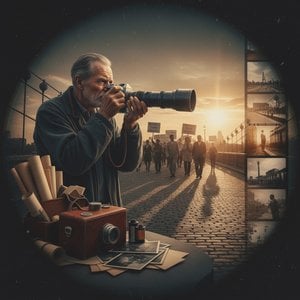
Anthony Joseph Barboza: A Life in Photography
Early Life and Origins
- Born in 1944 in New Bedford, Massachusetts, Anthony Joseph Barboza carries a rich heritage rooted in Cape Verdean ancestry.
- His upbringing significantly shaped his artistic vision, fostering an early awareness of cultural identity and social dynamics.
- Barboza’s connection to his roots would become a recurring motif throughout his career, informing his exploration of the African Diaspora.
Artistic Development & Transition
- Barboza began his artistic journey in commercial art over forty years ago, honing his technical skills and developing a keen eye for visual communication.
- He seamlessly transitioned into the realm of fine arts, dedicating himself to creating work that resonated with deeper social and political themes.
- His artistic development was marked by a commitment to using photography as a medium for storytelling and cultural commentary.
Key Works & Style
- Black Borders (1980) stands as one of Barboza’s most celebrated achievements. This photographic collection, supported by a grant from the National Endowment for the Arts, captured the vibrant energy and spirit of jazz musicians during the 1970s and '80s.
- His signature style is characterized by masterful use of lighting and shadow, carefully manipulated backdrops, precise shutter speeds, and thoughtful composition. These techniques create a dramatic and evocative atmosphere in his photographs.
- More recently, Black Dreams/White Sheets has garnered international attention for its poignant exploration of race, sexuality, gender, politics, and social issues within American society.
Influences & Themes
- Barboza’s work is deeply influenced by African-American thought and experience. He draws inspiration from the intellectual and artistic contributions of Black culture, using his art to amplify marginalized voices.
- Recurring themes in his oeuvre include identity formation, racial injustice, cultural memory, and the complexities of the human condition.
- He consistently challenges conventional perspectives, prompting viewers to confront uncomfortable truths about American history and contemporary society.
Exhibitions & Recognition
- Throughout his career, Barboza’s work has been exhibited in numerous public and private galleries, as well as prestigious museums and educational institutions worldwide.
- Black Dreams/White Sheets toured internationally, culminating in a showing at the Bill Hodges Gallery in New York City in 2010.
- His contributions to the art world have earned him recognition as a significant voice in contemporary photography and conceptual art.
Historical Significance
- Anthony Barboza’s work offers a powerful visual record of African-American life and culture, preserving the stories and experiences of generations.
- He has played a vital role in expanding the boundaries of photographic expression, pushing the medium to address complex social and political issues.
- Barboza’s legacy lies in his ability to create art that is both aesthetically compelling and intellectually stimulating, fostering dialogue and promoting understanding across cultural divides.
Q&A
주제별로 분류된 Anthony Joseph Barboza의 작품들은 어디에서 확인할 수 있나요?
주제별 작품 모음 페이지에서는 Anthony Joseph Barboza의 작품들을 주제별로 확인하실 수 있습니다.
키워드로 Anthony Joseph Barboza의 작품을 찾아볼 수 있나요?
Anthony Joseph Barboza의 작품은 아티스트의 키워드별 탐색 페이지에서 키워드별로 찾아보실 수 있습니다. 각 키워드를 통해 관련 작품들을 모아 감상하실 수 있습니다.
Anthony Joseph Barboza 작가의 작품 관련 통계 정보는 어디에서 확인할 수 있나요?
이 사이트에서 Anthony Joseph Barboza의 작품에 관한 통계를 확인할 수 있는 방문 통계 페이지를 만나보세요.