The Northern Michelangelo: The Life and Legacy of Andreas Schlüter
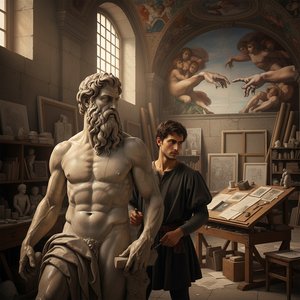
In the grand tapestry of European Baroque art, few names command as much reverence and mystery as Andreas Schlüter. Often hailed in his own lifetime as the "Northern Michelangelo," this extraordinary figure possessed a rare, dual mastery over both the chisel and the compass. As a sculptor and architect, he did not merely decorate buildings; he breathed a visceral, pulsating life into stone and structure. His career was a sweeping journey across the heart of the Holy Roman Empire, the Polish–Lithary Commonwealth, and eventually the burgeoning Russian Empire, leaving behind a trail of monuments that defined the very essence of the late Baroque style.
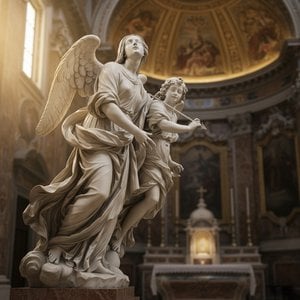
The early years of Schlüter remain shrouded in the mists of history, with scholars debating whether his origins lay in Hamburg, Germany, or Danzig, now Gdańsk. While the precise details of his apprenticeship are obscure, his talent was undeniable from his earliest known commissions. By the time he began decorating the facade of the Royal Chapel in Gdańsk, a signature style was already emerging—one that blended the bravura and grandeur of the Baroque with a uniquely tense, personal quality. This was an artist who could capture the heavy, naturalistic weight of an angel's wing or the grim, haunting realism of a dying warrior with equal, breathtaking precision.
A Journey Through the Courts of Europe
Schlüter’s professional ascent was driven by his ability to serve the highest echelons of power. His work in Warsaw, particularly the sculptural decorations for the Krasiński Palace and the Wilanów Palace, showcased a mastery of movement and drama that captivated the Polish court. However, it was his move to Berlin in 1694, at the invitation of Elector Frederick III, that would cement his place in history. In the Prussian capital, he became the architect of a new era, serving as the Court Architect and Director of the Prussian Academy of Arts.
His contributions to Berlin were nothing short of transformative. He was the visionary behind the monumental decorations of the Zeughaus (Arsenal), where his series of heads of dying warriors stands as a supreme example of his genius—works that, despite their martial setting, are said to reflect a profound, perhaps even pacifist, religious conviction. His architectural fingerprints are found throughout the city, from the intricate pulpit of St. Mary's Church to the ambitious designs for the Berlin City Palace. Perhaps most iconic is his equestrian statue of the Great Elector, Frederick William, a bronze masterpiece that embodies the dignity and power of the age.
Architectural Grandeur and Final Horizons
The scope of Schlüter’s ambition was matched only by the scale of his architectural undertakings. He approached architecture with a sculptor's eye, treating entire facades and interiors as singular, cohesive works of art. This is most evident in his work on the Berlin City Palace, where he sought to transform an electoral residence into a true royal palace. Even when faced with the tragic collapse of the Mint Tower—an event that brought an abrupt end to his official career in Berlin—his influence remained indelible.
In his final years, the call of the East beckoned. Summoned by Tsar Peter I of Russia, Schlüter traveled to Saint Petersburg, bringing his sophisticated German Baroque sensibilities to the foundations of a new imperial capital. He contributed significantly to the planning of the city and prepared designs for the magnificent Peterhof Palace complex, including the Grand Palace and Monplaisir Palace. Though he passed away in 1714, shortly after arriving in Russia, the legacy of Andreas Schlüter endured through the stone, bronze, and spirit of the monuments he left behind across a continent.
- Mastery of both sculpture and architecture
- Key works include the Zeughaus decorations and the equestrian statue of the Great Elector
- Influenced by the great masters such as Bernini and Michelangelo
- A pivotal figure in the development of the Late Baroque and Petrine Baroque styles
Q&A
Andreas Schlüter의 작품을 매체별로 찾아볼 수 있나요?
특정 매체로 제작된 Andreas Schlüter의 모든 작품을 확인하시려면, 작가의 모든 매체별 페이지를 이용해 주세요.
Andreas Schlüter 작가의 다른 활동명이나 알려진 이름이 있나요?
Andreas Schlüter은(는) Andreas Schluter라는 이름으로도 활동하고 있습니다.
Andreas Schlüter 작가의 작품을 연도별로 어떻게 확인할 수 있나요?
Andreas Schlüter의 작품을 연도별로 정리하여 보여주는 작품 연대기 페이지입니다.