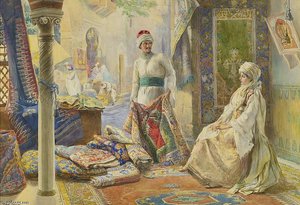
Amedeo Momo Simonetti: Bridging East and West Through Romantic Orientalism
Amedeo Momo Simonetti (1874–1922) stands as a singular figure in Italian art history, embodying the evocative spirit of Romantic Orientalism. A painter who masterfully captured the intersection of exotic landscapes and meticulously rendered Academic Realism, Simonetti possessed a rare ability to transport his audience from the streets of Europe to the vibrant, sun-drenched markets of North Africa. Born in Genoa but deeply connected to the artistic pulse of Rome, his journey was one of profound cultural synthesis, blending the disciplined techniques of Italian tradition with an unquenchable fascination for the "Orient."
His artistic lineage was steeped in both familial inspiration and formal rigor. Simonetti’s path toward the canvas was significantly shaped by his uncles, Ettore, an established Orientalist painter, and Attilio, who had been associated with the legendary Spanish master Mariano Fortuny. These early influences provided him with a window into the allure of distant lands long before he ever set foot in them. To refine this raw passion, he sought formal training at the Accademia Nazionale di Belle Arti di Roma. Under the guidance of masters such as Giuseppe Mengoni and Giovanni Costantini—the latter known as "Il Grillo"—Simonetti absorbed the essential tenets of Roman Academic Painting: a devotion to historical accuracy, precise tonal gradation, and a dramatic sense of narrative composition.
The Mastery of Light and the Moroccan Vision
The true brilliance of Simonetti’s work lies in his ability to use chiaroscary—the dramatic interplay of light and shadow—to breathe life into his subjects. He did not merely document scenes; he staged them with a theatrical grandeur that heightened their emotional impact. This technique is perhaps most breathtakingly realized in his monumental depictions of the Moroccan landscape. His 1897 masterpiece, “A Musical Interlude,” serves as a definitive testament to his skill, presenting a panoramic view of Marrakech’s Djemaa el-Fna square. In this work, the viewer is swept into a whirlwind of musicians, acrobats, and performers, all rendered with a meticulous brushwork that captures the tactile richness of Moroccan fabrics, ceramics, and ancient architecture.
Beyond the exoticism of the East, Simonetti’s repertoire was remarkably diverse. His early career saw him capturing the vanishing natural beauty of the Roman countryside, specifically the area around Prati, which was then undergoing rapid urbanization. This period of his work reflects a poignant sensitivity to the changing landscape of his homeland. Furthermore, he excelled in genre scenes depicting 18th-century figures—courtiers, musketeers, and church officials—set within lavish, historically detailed environments. Whether painting the dusty streets of Marrakech or the opulent halls of a bygone European era, his work remained anchored by an unwavering commitment to idealized beauty and psychological depth.
Legacy and Artistic Significance
Throughout his career, Simonetti earned significant recognition within the prestigious art circles of his time. His talent was frequently showcased on the grandest stages of the era, including:
- The Venice Biennale: Where he presented major works in 1904 and 1908, cementing his reputation among international collectors.
- The Milan International: A key exhibition in 1906 that highlighted his mastery of the Orientalist style.
- Associazione degli Acquarellisti Romani: An association of Roman watercolorists where he actively participated and contributed to the local artistic dialogue.
In his later years, Simonetti’s commitment to the pursuit of pure artistic expression led him to join the "XXV della campagna romana," an artists' society dedicated to free expression and informal camaraderie. This period marked a continuation of his devotion to the Roman landscape, a legacy he eventually shared with his son, Virgilio. Though his life was tragically short, ending in Rome in 1922, Amedeo Momo Simonetti left behind a body of work that remains a vital bridge between the disciplined traditions of Italian Academicism and the romantic, imaginative allure of the Orientalist movement.
Q&A
키워드별로 분류된 Amedeo Simonetti의 작품은 어디에서 볼 수 있나요?
특정 주제의 Amedeo Simonetti 작품을 찾으려면 키워드별로 작품이 분류된 작가의 키워드별 탐색 페이지를 이용해 보세요.
Amedeo Simonetti 작품의 연도별 타임라인이 있나요?
Amedeo Simonetti의 작품을 연도별로 정리하여 보여주는 작품 연대기 페이지입니다.
Amedeo Simonetti의 출생 도시와 국가는 어디인가요?
Amedeo Simonetti은(는) Italy Genoa에서 태어났습니다.
Amedeo Simonetti의 작품을 분위기별로 모아둔 곳은 어디인가요?
Amedeo Simonetti의 작품은 각 작품이 지닌 분위기에 따라 분류된 무드 룸 페이지에서 무드별로 감상하실 수 있습니다.