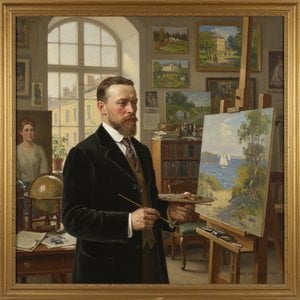
Early Life and Artistic Training
Born in Copenhagen on 13 October 1889, Albert Naur began his intellectual pursuits far from the canvas. Between 1908 and 1911, he dedicated himself to the study of Philosophy and Law in his native city. This academic foundation provided a structured beginning, yet the pull of visual expression proved too strong to ignore. The formal logic of law and the abstractions of philosophy eventually gave way to a more visceral calling.
In 1912, Naur made the decisive choice to leave Denmark for Paris, seeking to devote himself entirely to his craft. This move marked a significant shift from the theoretical to the practical. In the French capital, he sought rigorous instruction at the Académie de la Palette. There, he studied under the guidance of Fauconnier and Dunoyer de Segonzac, absorbing the technical discipline required to translate light and form onto a surface.
Artistic Style and Technique
Naur’s aesthetic evolution was marked by a steady movement away from rigid structures toward a more fluid expression. His early work leaned toward Naturalism, yet he found himself initially drawn to the geometric complexities of Cubism. This period of experimentation provided a foundation for his later transition into a linear form of Post-Impressionism. He did not remain tethered to the radicalism of the era, instead finding a way to balance structure with a more relaxed, observational approach to his subjects.
The artist’s relationship with light and color shifted significantly through his repeated visits to Paris in 1919 and 1922. These excursions acted as a catalyst for a change in his technical execution; his palette brightened, and his brushwork grew increasingly loose. He became particularly adept at capturing landscapes, imbuing them with an impressionistic breadth. His compositions often featured a sensual color glow that brought a sense of warmth to the natural world, moving beyond mere representation to capture the atmosphere of a specific moment.
His technical range allowed him to navigate both intimate still lifes and expansive outdoor scenes with ease. Whether working on a small scale or a larger canvas, his hand remained deliberate yet expressive. This versatility is evident in his ability to handle diverse subject matter, from the quietude of a landscape to the structured arrangement of objects on a table.
Awards and Recognition
The professional trajectory of Albert Naur was marked by steady validation from the academic and institutional circles of his time. His early promise was recognized in 1915 when he received the Hielmstierne-Rosencrone Prize. This initial distinction preceded a period of significant institutional support, as he was awarded the Akadamie Scholarship on four separate occasions, specifically in 1916, 1920, 1922, and 1924. These recurring honors provided a foundation for a career that bridged the gap between Danish traditions and the evolving modernism of the continent.
His reputation extended beyond the borders of Denmark, reaching the competitive art centers of France. In 1925, Naur was awarded a silver medal in Paris, a distinction that underscored his ability to hold his own among the international practitioners of the era. Such recognition helped secure his place in the formal record of European painters. His contributions are documented in the definitive Thieme-Becker and Benezit dictionaries of artists, ensuring his name remains part of the established historical lexicon of the medium.
Q&A
특정 매체로 분류된 Albert Naur의 모든 작품을 어떻게 찾을 수 있나요?
Albert Naur의 작품은 작가 페이지인 모든 매체별에서 매체별로 둘러보실 수 있습니다.
미술 사조별로 분류된 Albert Naur의 작품은 어디에서 볼 수 있나요?
모든 미술 사조 페이지에서는 Albert Naur의 작품을 예술 사조별로 모아 볼 수 있습니다.
Albert Naur은(는) 어느 시대의 작품을 남겼나요?
Albert Naur은(는) Modern 시대에 활동했습니다. 이 시기는 역사적 맥락 속에서 작가의 예술적 위치를 보여줍니다.
Albert Naur 작가의 작품을 연도별로 어떻게 확인할 수 있나요?
Albert Naur의 작품 연표를 확인해 보세요: 작품 연대기 페이지에서 작품들을 제작 날짜순으로 보실 수 있습니다.